
How We Reduced AWS Egress Fees (Real Architecture Changes That Paid Off)
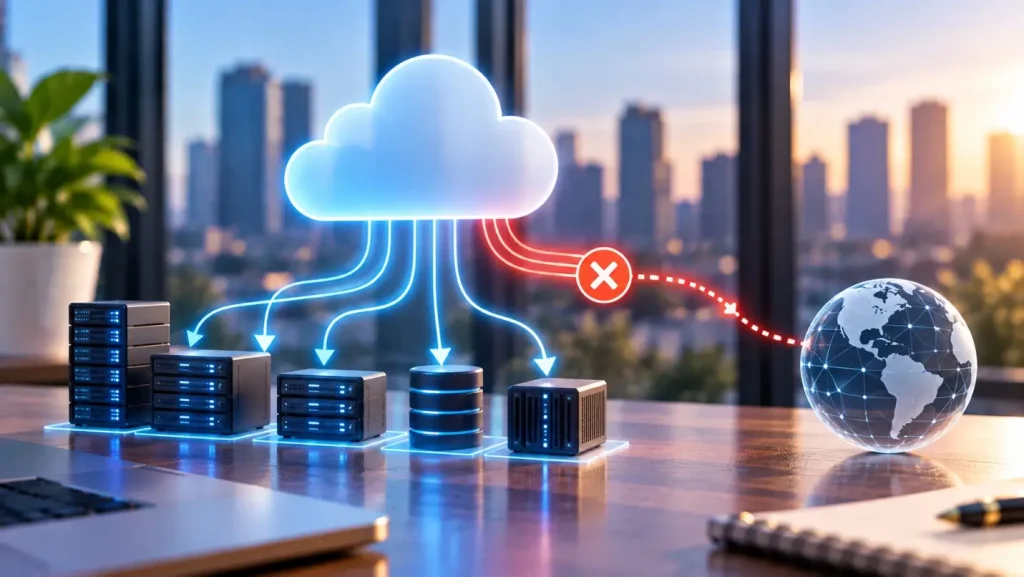
How to minimize cloud egress fees?
To dramatically reduce AWS data transfer egress costs, engineering teams must deploy a multi-layered architectural approach that intercepts data before it hits the public internet meter:
- Deploy VPC Endpoints: Route internal traffic to AWS services (like S3 or DynamoDB) through free VPC Gateway Endpoints rather than expensive NAT Gateways.
- Localize Inter-AZ Traffic: Optimize Kubernetes and microservices with topology-aware routing to prefer intra-AZ communication, bypassing the bidirectional $0.02/GB cross-Availability Zone penalty.
- Implement Multi-Region CDN Caching: Use Amazon CloudFront (which waives origin egress fees from S3 and EC2) or external CDNs to cache heavy payloads at the network edge.
- Establish Direct Cloud Interconnects: Route high-volume, on-premises or multi-cloud traffic through AWS Direct Connect to secure a reduced rate of ~$0.02/GB instead of the standard public internet rate of $0.09/GB.
I remember the exact moment our FinOps lead dropped the monthly cloud bill on my desk. We were scaling fast, hitting all our user acquisition targets, and feeling invincible. Then, I looked at the line item for AWS data transfer.
It wasn’t compute that was draining our runway. It wasn’t our sprawling database clusters or our machine learning inference nodes. It was egress. We were being taxed relentlessly simply for moving our own data out of the cloud and into the hands of our users.
In the cloud computing ecosystem, ingress is famously free. The hyperscalers want your data inside their walled gardens. But the moment that data needs to leave—whether to serve a web client, sync with an external API, or cross a regional boundary—the meter spins out of control. At $0.09 per gigabyte for the first 10 terabytes, the public internet data transfer rate is one of the most notoriously punitive line items in modern software engineering.
We had built a highly available, robust microservices architecture. Unfortunately, we had also built an incredibly efficient machine for generating AWS data transfer fees. We realized that if we didn’t fundamentally alter our network topology, our infrastructure costs would outpace our revenue growth.
This is the exact blueprint of how we tore down our architecture and rebuilt our routing layer to reduce AWS data transfer egress costs by over 60%, saving tens of thousands of dollars a month. No financial engineering, no reserved instance shell games—just hard, architectural refactoring.
Phase 1: The Audit and Escaping the Fog of War
You cannot optimize what you cannot see, and AWS billing dashboard charts are notoriously opaque when it comes to network flow. The standard invoices bundle massive varieties of traffic under generic headers like DataTransfer-Out-Bytes. To actually reduce AWS data transfer egress costs, you have to become an amateur network forensic analyst.
Our first move was abandoning the basic Cost Explorer and enabling the AWS Cost and Usage Report (CUR). We integrated CUR with Amazon Athena to allow us to write standard SQL queries against our billing data.
Almost immediately, the fog lifted. By querying the line_item_usage_type column, we separated our data transfer into three distinct buckets of pain:
- Public Egress: The infamous $0.09/GB toll for data leaving our Application Load Balancers (ALBs) to the wild internet.
- NAT Gateway Processing: A hidden tax where we were paying $0.045/GB just to route private subnet traffic to the internet, on top of the actual egress fees.
- Inter-AZ Transfer: A silent bleed of $0.02/GB (round trip) for microservices chatting with each other across Availability Zones.
Armed with Athena queries and VPC Flow Logs—which we temporarily sampled at a higher rate to identify the exact Elastic Network Interfaces (ENIs) acting as top talkers—we had our hit list.
Phase 2: Slaying the NAT Gateway Tax
The most offensive line item on our bill wasn’t even public egress; it was the NAT Gateway.
In a standard AWS deployment, best practices dictate placing your compute resources (EC2 instances, EKS worker nodes, Lambda functions) in private subnets. Because these resources don’t have public IP addresses, they require a NAT Gateway to reach the internet.
Here is the trap: if your private EC2 instance needs to pull a multi-gigabyte object from an Amazon S3 bucket, that traffic defaults to traversing the NAT Gateway. AWS charges $0.045 per gigabyte for NAT Gateway data processing. Furthermore, because the traffic is technically leaving your VPC to hit the regional S3 API endpoint, you are often double-billed for the privilege.
We had containerized microservices constantly pulling down machine learning models and large static assets from S3. We were paying thousands of dollars a month simply to move data between two AWS services within the exact same region.
The fix was conceptually simple but required rigorous infrastructure-as-code (IaC) updates: we deployed VPC Gateway Endpoints for S3 and DynamoDB.
A Gateway Endpoint alters the route table of your VPC. Instead of sending S3-bound traffic out to the NAT Gateway, the route table directs it through a dedicated, internal AWS network path. The cost for utilizing a VPC Gateway Endpoint? Zero.
Implementing this immediately amputated our NAT Gateway processing costs. However, we didn’t stop there. We realized our microservices were also constantly querying AWS Systems Manager (SSM), CloudWatch, and Secrets Manager. For these, we deployed VPC Interface Endpoints (powered by AWS PrivateLink). While Interface Endpoints cost $0.01 per GB plus a small hourly fee, it was vastly cheaper than the $0.045/GB NAT Gateway toll.
The architectural takeaway: Never allow AWS-to-AWS API calls to traverse a NAT Gateway. Keep your internal cloud traffic strictly inside the VPC boundary.
Phase 3: The Silent Bleed of Inter-AZ Traffic
High availability is the bedrock of cloud architecture. To survive outages, you distribute your workloads across multiple Availability Zones (AZs) within a region (e.g., us-east-1a, us-east-1b, us-east-1c).
But high availability comes with a hidden subscription fee. While ingress from the internet is free, AWS charges $0.01/GB for data leaving an AZ, and another $0.01/GB for data entering the destination AZ. Because typical microservice communication relies on request and response payloads, you effectively pay a $0.02/GB round-trip tax every time a service in AZ-A talks to a service in AZ-B.
In our Kubernetes (Amazon EKS) clusters, we had blindly deployed a heavily abstracted service mesh. A frontend pod in AZ-A would query a backend pod. Because Kubernetes utilizes round-robin load balancing by default via kube-proxy, that request had a 66% chance of crossing an AZ boundary in a three-AZ setup.
When you scale this to thousands of requests per second, transmitting hefty JSON payloads and gRPC streams, the AWS data transfer pricing model acts like a slot machine for the cloud provider.
To fix this, we implemented Topology-Aware Routing. By configuring our Kubernetes service manifests with the topologyKeys attribute (and later transitioning to the newer Topology Aware Hints feature in modern K8s), we instructed the Kubernetes control plane to heavily prefer routing traffic to pods within the same Availability Zone as the requester.
Traffic would only spill over to a different AZ if the local pods were overwhelmed or failing. Furthermore, we audited our Apache Kafka and Redis clusters. We realized our Kafka replication factor was generating massive cross-AZ traffic. By compressing messages at the producer level before they were replicated across the wire, we mathematically reduced the byte volume crossing the AZ boundaries by 40%.
These changes didn’t compromise our fault tolerance—if an AZ went down, the system would still failover gracefully. We simply stopped paying the cloud provider a premium for random, unnecessary lateral network hops.
Phase 4: Edge Caching and the Multi-Region CDN Strategy
Once we had locked down the internal bleeding within our VPC and across our Availability Zones, we turned our attention to the final boss: public internet egress.
Our application served a massive amount of media, JSON configurations, and dynamic API responses to client devices globally. Initially, every single one of those requests routed straight through the internet into our ALBs, hitting our backend services, and incurring the full $0.09/GB egress fee on the way back out.
The golden rule of minimizing public egress is simple: Never serve the same byte twice from your origin.
We aggressively implemented Amazon CloudFront. The financial incentive here is structural: AWS waives the origin fetch data transfer fee when data moves from an AWS origin (like S3, EC2, or an ALB) to CloudFront. You only pay for the CloudFront egress to the internet, which is tiered and generally cheaper than raw EC2 egress, especially with committed usage discounts.
However, we didn’t just slap a CDN in front of our domain and call it a day. We fundamentally re-engineered our application payloads to be cache-friendly.
- Aggressive Cache-Control: We audited our headers, pushing max-age limits on static assets to a year, utilizing immutable cache directives, and heavily leveraging ETag validation to prevent re-downloading unchanged data.
- Edge Compute: Using CloudFront Functions, we manipulated request headers at the edge to normalize query strings. Previously, minor variations in query parameters were causing massive cache misses, forcing traffic back to the origin. By normalizing these at the edge, our cache hit ratio skyrocketed from 64% to 91%.
- Compression: We ensured Brotli compression was strictly enforced. It is astounding how many engineering teams pay premium egress rates to transmit uncompressed, whitespace-heavy JSON over the wire.
For a subset of our highly specialized, egress-heavy static asset delivery, we explored multi-cloud strategies. The open-internet community has been fighting back against egress lock-in. By utilizing external providers participating in the Cloudflare Bandwidth Alliance, companies can route traffic through partnered clouds that discount or entirely waive egress fees to Cloudflare’s network. While AWS is notably absent from this alliance, we shifted a portion of our long-term archival storage and heavy media processing to alternative object stores that supported zero-egress policies, putting a hard ceiling on our media delivery costs.
Phase 5: Bypassing the Public Internet Meter Entirely
As our B2B enterprise client base grew, we noticed a new anomaly. A few massive enterprise customers were pulling down terabytes of data daily via our APIs to synchronize with their own internal data lakes. We were eating the $0.09/GB cost to send data over the public internet to their corporate data centers.
For these high-volume, dedicated pipelines, the public internet is simply the wrong transport layer—both financially and from a security perspective.
To solve this, we worked with our largest clients to establish AWS Direct Connect (often facilitated through software-defined network partners like Megaport). Direct Connect bypasses the public internet entirely, establishing a dedicated fiber link between an AWS region and a corporate data center or colocation facility.
The financial arbitrage is undeniable. While Direct Connect requires paying for physical port hours, the data transfer out rate plummets to roughly $0.02 per GB (depending on the location pair). Once a client was pulling more than a few terabytes a month, the math heavily favored the fixed-port cost of Direct Connect over the variable punishment of standard internet egress. It was a win-win: our clients received private, lower-latency, highly secure throughput, and we entirely removed their heavy-lifting API usage from our public egress billing tier.
The Compounding Return on Traffic Topology
Cost optimization in the cloud is rarely about finding a magic coupon code; it is an exercise in architectural discipline. The hyperscalers have engineered their pricing models to tax architectural laziness. If you rely on default routing, standard NAT deployments, and round-robin load balancing, you will subsidize the cloud provider’s margins.
By enforcing strict egress boundaries, pulling our internal traffic off the NAT Gateways, aggressively leveraging VPC endpoints, localizing our Kubernetes pod communication, and caching ruthlessly at the edge, we didn’t just reduce our AWS data transfer egress costs—we built a faster, more resilient system.
Network topology is destiny in cloud engineering. When you stop treating network routing as an abstract utility and start treating it as a core software dependency, the financial returns compound month after month. The bandwidth tollbooth can be bypassed, but only if you are willing to build the right roads.
