
7 Largest Heavy Equipment GPS Apps as Fleet Idle Times Cost Contractors $5 Billion Annually
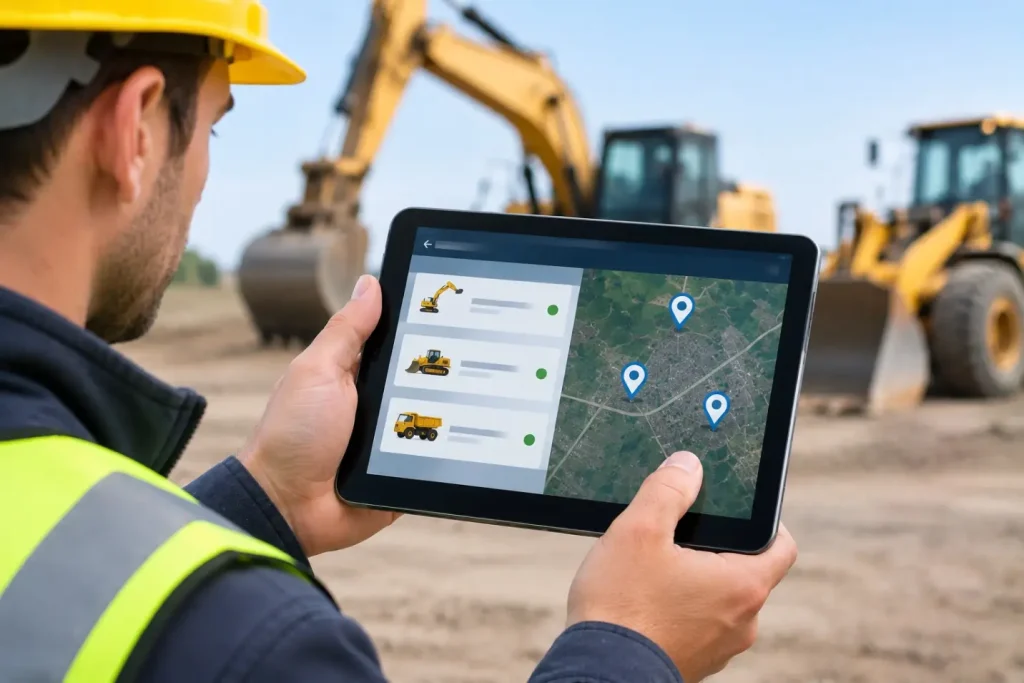
A stolen John Deere 85G excavator costs a contractor roughly $150,000 to replace. The liquidated damages from the resulting two-week project delay often exceed half a million dollars. That brutal arithmetic is forcing civil contractors to abandon legacy spreadsheet tracking and adopt deeply integrated heavy equipment telematics. The off-highway fleet management sector is currently compounding at an 11.2% annual growth rate. Institutional capital is flowing heavily into the space as the market races toward a $12 billion total addressable valuation by 2028.
Hardware is no longer the profit center in this industry. Tracking a bulldozer on a digital map is a solved problem with near-zero margins. The actual enterprise value lies in the software layer and the ability to ingest complex proprietary data from heavy machinery. Modern GPS applications plug directly into a machine’s diagnostic port to read J1939 fault codes. This allows fleet managers to detect a failing hydraulic pump on a wheel loader three weeks before the operator notices a drop in pressure. Predictive maintenance keeps yellow iron moving and protects project margins.
Mixed fleet environments complicate this data extraction. A standard heavy highway contractor might operate Caterpillar excavators, Komatsu dozers, and Volvo articulated trucks on the same site. Each manufacturer historically walled off their engine data to force contractors into proprietary dealership maintenance programs. The widespread adoption of heavy equipment OEM integration standards broke this monopoly. Contractors now demand software that aggregates data from every equipment brand into a single pane of glass. Providers failing to support these API standards are being rapidly rotated out of enterprise vendor stacks.
Fuel consumption remains the heaviest operational line item for these companies. An idling 30-ton excavator burns nearly a gallon of diesel per hour while producing zero economic value. Aggregating engine idle time fuel consumption across a fleet of two hundred machines reveals massive capital bleeds. The top applications in the market automate this analysis by triggering manager alerts when machines idle beyond specific time thresholds.
Our Methodology
We ranked the top heavy equipment tracking applications based on verified off-highway connected assets and annualized recurring revenue generated from commercial construction clients. We excluded consumer-grade GPS trackers and basic OBD-II plug-in devices designed for passenger vehicles. Heavy machinery requires ruggedized telematics gateways capable of surviving extreme vibration, dust, and voltage spikes.
Our evaluation required native compatibility with AEMP 2.0 API standards. We audited the telematics subscription gross margins of publicly traded providers and estimated the software revenue multiples of private entities. We penalized platforms that rely heavily on third-party hardware white-labeling because controlling the entire data pipeline from the gateway to the cloud is necessary for sub-second latency reporting.
7. Verizon Connect
Global Active Fleet Connections: 2.1 Million
Telecommunications giants rarely succeed in specialized industrial software. Verizon Connect is the exception due to the sheer scale of its underlying cellular infrastructure and massive legacy customer base. The platform evolved from a series of aggressive acquisitions, most notably the $2.4 billion purchase of Fleetmatics. This provided Verizon with immediate penetration into the commercial tracking market. Their Reveal platform serves as the central hub for dispatchers monitoring mixed assets across multiple regional job sites.
The platform excels at basic utilization reporting and geofencing. Contractors draw digital perimeters around job sites and receive immediate alerts if an asset moves outside the boundary during off-hours. This specific functionality directly mitigates risks highlighted in the latest annual construction equipment theft report. The hardware gateways are highly standardized and offer rapid installation times for field mechanics.
Verizon Connect struggles slightly with deep engine diagnostics on niche heavy equipment compared to pure-play construction platforms. Their pricing structure reflects volume discounting designed to lock in entire corporate fleets including white-box trucks and heavy excavators. Average revenue per user remains compressed near $35 per month per asset due to aggressive competitive bidding on large enterprise contracts.
6. Tenna
Enterprise Construction ARR Growth: 42%
Tenna ignores the standard trucking market entirely to focus exclusively on construction assets. They segment their tracking hardware by asset class. They deploy ruggedized cellular trackers for heavy iron, Bluetooth low energy tags for attachments like hydraulic breakers, and QR codes for small hand tools. This localized tracking hierarchy allows a superintendent to view an entire equipment inventory on a single app screen.
The platform architecture is built around equipment lifecycle costing rather than simple dot-on-a-map tracking. Tenna calculates depreciation, preventative maintenance schedules, and active utilization against the initial capital expenditure of the machine. The software forces field mechanics to log daily inspection reports directly into the app before turning the ignition key. This creates a highly accurate, auditable paper trail for OSHA compliance and warranty claims.
Their integration depth with major construction ERP systems like Viewpoint and Procore drives their enterprise retention. When a fleet manager assigns a motor grader to a specific job site in Tenna, the software automatically allocates the hourly equipment cost to that project’s budget in the accounting software. The company recently secured an additional $22 million in Series B funding to expand this specific ERP integration mapping.
5. Teletrac Navman
Heavy Equipment Units Under Management: 450,000
Vontier acquired Teletrac Navman to bolster its industrial technology portfolio. The company holds a massive footprint in civil engineering and heavy highway construction. Their Director software platform is highly customized for government compliance and complex bidding environments. Contractors working on federal infrastructure projects use the system to generate automated utilization reports required for prevailing wage and equipment rate reimbursements.
The hardware ecosystem is notoriously durable. They utilize dual-mode tracking gateways that automatically switch from cellular networks to Iridium satellite networks when heavy equipment operates in remote environments with zero cell towers. This satellite redundancy is mandatory for pipeline contractors and logging operations.
Their recent product iterations focus on automated maintenance workflows. The system ingests fault codes and automatically orders replacement parts from authorized dealers without human intervention. Teletrac Navman maintains gross software margins exceeding 70% by upselling these advanced predictive maintenance modules to their legacy tracking customers.
4. Trimble
Construction Segment Revenue: $850 Million
Trimble dominates the heavy construction technology space through its legacy in spatial positioning and grade control. Most modern bulldozers and graders arrive from the factory pre-wired for Trimble 3D machine control systems. The company naturally expanded this physical footprint into fleet management and telematics. Their Earthworks platform tracks equipment location while simultaneously monitoring the exact volume of dirt a machine moves per hour.
This convergence of fleet tracking and productivity tracking changes the unit economics of a job site. A standard GPS app tells a manager that an excavator ran for eight hours. Trimble tells the manager that the excavator ran for eight hours and moved 1,200 cubic yards of material at a specific elevation. This data allows contractors to measure their daily operational output against their original project estimates.
The company operates with a high barrier to entry because contractors invest hundreds of thousands of dollars into Trimble base stations and rover setups. Switching telematics providers requires ripping out deeply embedded hardware. Trimble reported a 14% year-over-year increase in recurring software revenue for their civil construction division during their most recent quarterly earnings call.
3. Trackunit
Verified Off-Highway Connected Assets: 1.2 Million
Trackunit is a massive European entity that rapidly captured North American market share through a singular focus on the off-highway sector. Their acquisition of ZTR Control Systems essentially doubled their engineering capacity and secured deep relationships with major equipment rental houses. Equipment rental giants like United Rentals and Sunbelt require hyper-accurate telematics to bill customers for precise engine hours and prevent off-contract usage.
The platform eliminates the need for proprietary hardware through a massive API ecosystem. Trackunit Iris ingests data directly from Caterpillar’s VisionLink and John Deere’s JDLink servers. This allows fleet managers to view every machine on one screen without installing aftermarket tracking boxes. When aftermarket hardware is required, their raw tracking units are completely potted in epoxy to prevent water and dust intrusion.
Trackunit is aggressively pursuing access control technologies. Their dual-ID system requires an operator to swipe a customized RFID card or use a smartphone app to start a machine. This prevents untrained personnel from operating a $400,000 piece of equipment. The company currently commands a valuation multiple exceeding ten times their annualized recurring revenue.
2. EquipmentShare
Implied Valuation: $3.3 Billion
EquipmentShare began as a peer-to-peer equipment rental marketplace before pivoting into a dominant industrial SaaS provider. The founders realized that building a rental business required a proprietary tracking system to monitor their own assets. They built the T3 operating system to track machine health, operator behavior, and fuel burn. Construction companies noticed the software quality and began purchasing T3 to manage their owned fleets rather than just renting machines.
The platform bridges the gap between physical machinery and back-office accounting. T3 automatically generates timecards based on when an operator starts a specific machine. It tracks off-highway fleet utilization rates across different asset classes to alert procurement teams when they have too many bulldozers sitting idle on one site while renting the same equipment on another site across town.
Their aggressive expansion is fueled by massive capital injections. EquipmentShare raised $290 million in 2023 to expand their national footprint and refine their proprietary hardware. They operate physical rental yards that serve as localized distribution and installation hubs for their telematics software. Their blended gross margin profile mixes high-margin SaaS revenue with capital-intensive hardware rentals.
1. Samsara
Annualized Recurring Revenue: $1.1 Billion
Samsara executed the most successful software disruption in the history of industrial fleet management. The company treats heavy equipment as just another node on a massive Internet of Things architecture. They do not distinguish heavily between a Peterbilt semi-truck and a Komatsu excavator. Their platform ingests data from heavy equipment gateways, dashboard cameras, and physical site sensors into a remarkably clean user interface that requires zero training to operate.
The integration of artificial intelligence into their dashcam products sets the industry standard. While geofencing and idle time tracking are standard features, Samsara uses machine vision to detect when a heavy equipment operator is distracted or using a mobile phone. This physical risk mitigation directly lowers commercial insurance premiums for large civil contractors. They rapidly expand their enterprise accounts by proving direct return on investment through reduced accident claims and lowered fuel expenditures.
The company achieved cash flow positivity faster than Wall Street analysts projected following their initial public offering. Samsara operates with extreme sales efficiency and a net retention rate consistently hovering above 115%. They spend heavily on research and development to maintain software superiority. During their last fiscal quarter, the company allocated $68 million strictly toward expanding their cloud infrastructure and data processing capabilities.
