
Best Agentic AI Orchestration Platforms for Enterprise Swarms in 2027
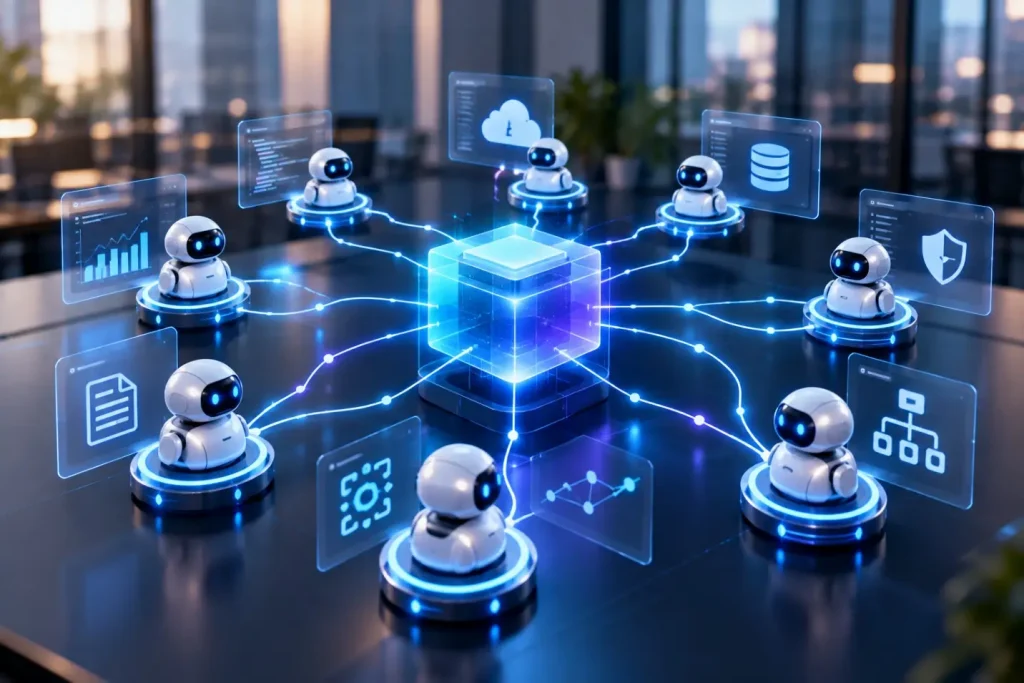
Enterprise software engineering has officially hit the limits of the monolithic Large Language Model (LLM). Throughout the initial rollouts of enterprise generative AI, organizations tried to force single models to do everything: parse unstructured customer intake, query internal Postgres databases, enforce regional compliance rules, and fire transactional mutations into systems of record. The results were predictably messy. Monolithic models suffer from context dilution, hallucinate parameters when schemas shift, and lock up when faced with complex, multi-stage business operations.
As engineering teams establish their roadmaps heading into 2027, the paradigm has shifted permanently from standalone chatbots to autonomous swarms. Rather than relying on a single prompt to solve a hundred-step business problem, organizations are deploying networks of single-purpose, domain-specialized software agents operating under a central control layer.
This is microservices architecture applied to machine intelligence. But deploying dozens or hundreds of autonomous agents introduces a severe operational hurdle: distributed state management, token economics, race conditions, and catastrophic tool failure. For Chief Technology Officers, VPs of Engineering, and automation directors, evaluating the best multi-agent orchestration platforms has become the defining infrastructure decision of the enterprise software stack.
What is the best platform for multi-agent orchestration?
The best platform for multi-agent orchestration depends on engineering culture, technical governance, and cloud infrastructure ownership. For developer teams requiring absolute code-level control and stateful cyclic graphs, LangGraph is the industry standard. For organizations running within Microsoft-centric enterprises that demand native identity governance and Microsoft 365 integration, Microsoft Copilot Studio offers the strongest enterprise surface. For serverless infrastructure with high-throughput event processing, Amazon Bedrock AgentCore leads in managed scalability, while Kestra delivers superior declarative orchestration across hybrid and data-heavy environments.
Enterprise automation directors evaluating multi-agent orchestration platforms heading into 2027 prioritize three non-negotiable technical requirements:
- Model Context Protocol (MCP) support: Universal, open-standard integration to connect models to external data and internal APIs without brittle, one-off glue code.
- Self-healing workflows: The ability of the runtime engine to catch malformed outputs, schema mismatches, or API timeouts, and feed the error trace back to the agent for bounded, in-context self-correction.
- Deterministic ERP tool-calling: Sandboxed, schema-validated execution layers that prevent probabilistic models from making unverified write operations to transactional backbones like SAP, Salesforce, or Workday.
|
Platform |
Core Strength |
MCP Support |
Self-Healing Capability |
ERP Tool-Calling Engine |
Primary Fit |
|
LangGraph |
Cyclic state graphs & granular developer control |
Native client & server runtime |
Advanced (Programmatic custom error-handling loops) |
Custom API / OpenAPI specifications |
Python/TypeScript development teams building bespoke swarm logic |
|
Microsoft Copilot Studio |
Deep Microsoft 365, Entra ID, and Dataverse integration |
Native protocol gateway integration |
Built-in (Deterministic fallbacks & escalation) |
Native Power Platform connectors, SAP, Dynamics |
Enterprises operating primarily within Azure and Office 365 |
|
AWS Bedrock AgentCore |
Serverless scale, Lambda-native execution, multi-model choice |
Native tool discovery & integration |
Infrastructure-level (Automated model retry & routing) |
AWS Action Groups & PrivateLink ERP endpoints |
High-throughput, AWS-native transactional pipelines |
|
Kestra |
Declarative orchestration, event-driven data workflows |
Native MCP server orchestration |
Configurable (Task-level backoff, restart, & state save) |
200+ enterprise plugins & legacy integrations |
Platform engineering teams managing hybrid cloud and legacy systems |
|
CrewAI Enterprise |
Role-based collaboration and hierarchical swarms |
Native MCP integration |
Intermediate (Role-based re-prompting) |
Custom tools & standard webhooks |
Cross-functional research, audit, and operational task forces |
The Plumbing Layer: Why MCP Upended Agent Integration
To understand modern agentic orchestration, you have to look at the protocol stack beneath the runtime. In the early days of agent development, connecting an LLM to an internal software tool required writing bespoke JSON schemas and hardcoded REST wrappers. If an engineering team updated an API parameter or modified database access rules, the agent crashed or hallucinated calls to non-existent endpoints.
The breakthrough came with the open standard detailed in the Model Context Protocol announcement by Anthropic. MCP establishes a client-server architecture for AI context, serving as an open, universal standard for connecting models to external systems. Instead of engineering distinct connectors for every repository, database, and internal microservice, developers expose data and capabilities through standardized MCP servers.
MCP standardizes tool declaration, resource discovery, and context transport. However, an interface protocol is not an execution runtime. MCP does not handle distributed execution queues, state persistence, memory consolidation, authorization tokens, or catastrophic failure recovery. That operational responsibility belongs to the orchestration platform.
By separating the protocol layer from the orchestration logic, enterprise platforms allow engineering teams to build vendor-agnostic systems. If a team develops a fleet of MCP-compliant tools for an internal billing engine, they can switch the underlying intelligence from Claude to OpenAI or to self-hosted open weights like Llama without touching a single line of backend integration plumbing.
Architectural Deep Dives: Top Swarm Platforms
The market for multi-agent platforms has divided into clear architectural philosophies: programmatic code-first frameworks, enterprise-governed SaaS environments, cloud-native infrastructure, and declarative data engines.
1. LangGraph: The Programmable State Engine
Emerging from the LangChain ecosystem, the LangGraph agent orchestration framework was built to solve the limitations of linear, Directed Acyclic Graph (DAG) workflow runners. Real-world business operations rarely flow in a straight line; they loop, branch, pause for input, hit edge cases, and cycle back for revision.
Technical Architecture
LangGraph models multi-agent execution as stateful cyclic graphs. Nodes in the graph represent units of work—such as calling an LLM, querying an MCP tool, or waiting on human input—while edges represent transition conditions based on the current state. State is immutable, typed, and persistently snapshotted into durable storage (such as PostgreSQL or Redis) after every node transition.
This persistence model provides native support for long-running workflows. If an agent executes a multi-step financial audit that requires human authorization, the graph saves its exact memory state and suspends execution. It can sit dormant for days, waking up instantly when a webhook delivers the human approval.
Developer Experience & Trade-offs
LangGraph is written for software engineers who want zero abstractions between their code and the runtime. It offers total transparency: you define the state schema, you control the context window trimming, and you write the routing logic.
The downside is development friction. There is no visual drag-and-drop builder for non-technical product managers. Building resilient systems in LangGraph requires disciplined software engineering practices, deep familiarity with asynchronous Python or TypeScript, and meticulous schema design.
Strategic Fit
Ideal for core product engineering teams building bespoke AI applications where the multi-agent swarm is the product itself, and where complete architectural flexibility and self-hosting inside an enterprise VPC are required.
2. Microsoft Copilot Studio: The Regulated Governance Hub
Microsoft approached the multi-agent problem through the lens of enterprise administration, compliance, and enterprise data security via the Microsoft Copilot Studio agent architecture.
Technical Architecture
Copilot Studio is built directly on Microsoft Azure, the Power Platform, and Microsoft Dataverse. Its standout enterprise capability is identity propagation. In a standard open-source framework, an agent often operates using a shared administrative service account, creating an audit vulnerability. Copilot Studio binds each agent’s execution context directly to the user’s Microsoft Entra ID.
If an agent within a swarm attempts to read an executive email, parse a SharePoint document, or call a Dynamics 365 endpoint, it executes strictly within the permissions of the authenticated corporate user. If the user lacks access to the payroll table in SAP, the agent cannot access it, eliminating prompt injection attacks aimed at privilege escalation.
Developer Experience & Trade-offs
The platform provides a hybrid canvas that allows technical analysts to visually assemble multi-agent flows while giving professional developers access to code-level extensions via Azure AI Foundry and custom connector APIs.
The trade-off is aggressive ecosystem lock-in. While Microsoft supports external endpoints, the platform functions with the lowest latency and highest stability when organizations remain within the Azure, Office 365, and Power Platform footprints.
Strategic Fit
The premier option for Fortune 500 organizations, healthcare networks, and financial institutions deeply embedded in the Microsoft stack that require immediate SOC 2, HIPAA, and ISO compliance without building custom governance middleware.
3. Amazon Bedrock AgentCore: The Serverless Cloud Pipeline
Amazon Web Services strips away conversational abstractions and approaches agent orchestration as a core cloud infrastructure component through the Amazon Bedrock multi-agent collaboration platform.
Technical Architecture
Bedrock AgentCore treats agents as serverless cloud primitives. Instead of managing long-running container pods to host agent processes, Bedrock dynamically coordinates agent execution loops on top of AWS managed infrastructure. Agents use Action Groups to map natural language reasoning directly into AWS Lambda functions or private network API endpoints via AWS PrivateLink.
Bedrock handles prompt decomposition, context collection from Amazon OpenSearch Serverless vector databases, and multi-agent delegation natively. AWS provides high compute throughput and regional data residency, making it possible to execute massive numbers of concurrent agent threads without network throttling.
Developer Experience & Trade-offs
Bedrock is an engineering-first platform configured via the AWS Management Console, CloudFormation, or the AWS CDK. It does not provide consumer-facing interfaces. Debugging non-deterministic agent failures requires navigating AWS CloudWatch log groups, distributed tracing in AWS X-Ray, and fine-tuning IAM permission boundaries.
Strategic Fit
High-throughput transactional environments—such as fraud prevention swarms, real-time supply chain adjustments, and adtech automation—that run in an AWS-native stack and require private network isolation without internet traversal.
4. Kestra: Declarative and Event-Driven Orchestration
Kestra emerged from the data engineering ecosystem to establish itself as a flexible orchestrator for both deterministic software pipelines and non-deterministic agent swarms.
Technical Architecture
Kestra operates on declarative YAML workflow definitions. Instead of requiring engineers to write custom orchestration code, Kestra allows teams to define complex, event-driven topologies where an AI agent step runs right alongside a Docker container, an Apache Spark data transform, a Python script, or an enterprise database mutation.
Kestra treats multi-agent systems as microservice tasks. If a task requires calling an MCP server to extract structured metadata from an S3 bucket, Kestra handles the container lifecycle, schedules the execution, saves the intermediate output to object storage, and manages downstream dependencies based on real-time event triggers.
Developer Experience & Trade-offs
Kestra bridges the gap between infrastructure teams and software developers. Its browser-based topology graph gives clear visibility into workflow execution, task timing, and resource utilization.
However, it is fundamentally an infrastructure and pipeline orchestrator rather than an interactive agent research lab. Teams looking for native prompt-tuning sandboxes, human conversational evaluation metrics, or rapid persona prototyping will need to pair Kestra with dedicated LLMOps tooling.
Strategic Fit
Data engineering and platform operations teams that need to incorporate autonomous AI agents directly into scheduled ETL workflows, hybrid-cloud pipelines, and existing event-driven enterprise architecture.
5. CrewAI Enterprise: The Role-Based Organizational Framework
CrewAI took a distinct path by modeling multi-agent systems after human organizational hierarchies, team roles, and collaborative dynamics.
Technical Architecture
In CrewAI, developers instantiate agents by specifying their role, goal, and backstory. These parameters are not merely cosmetic; the framework uses them to construct structured system prompts that maintain domain isolation. A “Compliance Auditor” agent automatically approaches a problem with a different reasoning strategy and toolset than a “Rapid Data Collector” agent.
CrewAI Enterprise provides orchestration patterns ranging from sequential handoffs to hierarchical models where a designated “Manager Agent” dynamically assesses project deliverables, critiques work quality, and delegates follow-up tasks to specialized sub-agents. It features sophisticated memory caching, maintaining short-term working context, long-term vector embeddings, and cross-agent shared scratchpads.
Developer Experience & Trade-offs
CrewAI has one of the gentlest learning curves in the industry, making it an excellent choice for rapid prototyping and business process exploration.
The primary challenge in production is controlling non-deterministic operational costs. When agents are granted wide autonomy to converse, challenge each other’s outputs, and delegate tasks, they can slip into cyclical discussion loops that consume tokens quickly. Establishing strict operational budgets, timeout conditions, and exit gates is critical.
Strategic Fit
Knowledge-work automation where problems are ambiguous, iterative, and require cross-functional synthesis, such as competitive market research, legal discovery analysis, and automated code review pipelines.
Architectural Patterns: Designing the Enterprise Swarm
Building a multi-agent system requires choosing an operational structure that balances autonomous discovery with deterministic reliability. Across modern enterprise deployments, three core architectural patterns dominate, as detailed in the IBM Think architectural guide to multi-agent orchestration.
1. The Sequential Pipeline (Strict Determinism)
The sequential pipeline is the baseline architecture for heavily regulated workflows, including financial account reconciliations, insurance claims intake, and clinical document parsing.
In this pattern, tasks move in an immutable, linear progression. Agent A processes raw, unstructured input into a structured, validated data schema. That schema is passed directly to Agent B, which cross-references internal compliance policies. Once validated, Agent C formats the operational payload for transaction execution.
No agent has the autonomy to skip a stage or alter the sequence. If an agent fails to generate a valid schema, the entire pipeline halts immediately and alerts an operator. This delivers maximum predictability and simple audit logging.
2. The Scatter-Gather Fleet (Horizontal Parallelism)
When processing vast amounts of independent data points, sequential execution is too slow and running everything through a single context window triggers context dilution.
The Scatter-Gather pattern relies on an orchestrator that breaks an enterprise batch task into independent segments. For example, during vendor contract review across thousands of supplier agreements:
- A centralized Router Agent segments the document collection.
- It spins up dozens of identical, lightweight Worker Agents executing in parallel across isolated runtime containers.
- Each worker processes its assigned document against a strict extraction criteria.
- An Aggregator Agent collects the structured JSON outputs, reconciles cross-contract dependencies, identifies anomalies, and generates an executive summary.
This pattern cuts execution time from hours to seconds and prevents context degradation.
3. The Hierarchical Supervisor (Dynamic Delegation)
For complex, multi-stage business challenges, organizations implement a hierarchical supervisor pattern. A high-parameter reasoning model serves as the project supervisor. It accepts a high-level operational objective (e.g., “Analyze customer churn spikes in Q3 across the EMEA region and implement automated retention campaigns”).
The supervisor evaluates the request, establishes an execution plan, and assigns sub-tasks to specialized worker agents with restricted toolkits:
- Data Agent: Queries the Snowflake data warehouse via an MCP server.
- Analysis Agent: Performs statistical correlation in an isolated Python sandbox.
- Execution Agent: Drafts promotional campaigns inside the marketing automation engine.
The critical element is the evaluation feedback loop. The supervisor does not simply accept worker outputs; it inspects them against predefined acceptance tests. If the Data Agent returns an incomplete dataset, the supervisor rejects the output, supplies corrective context, and instructs the agent to query again.
Production Reliability: Self-Healing and Human Checkpoints
The difference between a flashy hackathon prototype and a reliable enterprise platform is error handling. LLMs are non-deterministic reasoning engines operating in a world of deterministic, unforgiving APIs. If an external service is unavailable, an endpoint schema changes, or a model emits an unescaped string, the orchestration platform must recover gracefully.
The Closed-Loop Self-Healing Cycle
In a production-ready multi-agent platform, errors are treated as context, not application crashes:
- Deterministic Syntax Validation: When an agent outputs a tool-call payload, the platform validates the JSON against typed schemas (e.g., Pydantic or TypeScript interfaces) before the network request executes.
- In-Context Error Reflection: If an API endpoint returns an error (such as an HTTP 422 Unprocessable Entity or an internal database error), the orchestrator intercepts it. Instead of throwing an unhandled exception, it appends the raw system trace directly into the agent’s short-term memory:
“System Notice: The previous call to execute_invoice_adjustment failed with code 422: ‘The field tax_jurisdiction_code is required for regional corporate entities.’ Adjust your parameters and retry.” - Bounded Retries: The platform caps automatic retries (typically at three attempts). This gives the model the opportunity to analyze the trace and fix parameter formatting while preventing infinite, token-draining retry loops.
Human-in-the-Loop (HITL) Checkpoints
When self-healing fails, or when an action exceeds predefined risk boundaries, the orchestrator triggers an asynchronous Human-in-the-Loop (HITL) checkpoint.
Modern orchestrators handle this through durable execution state. When a transaction involves high-risk actions—such as updating banking credentials, deleting data, or initiating wire transfers above a designated threshold—the engine:
- Pauses the execution graph.
- Serializes the entire state (conversation history, tool-call parameters, and reasoning traces) to an enterprise database.
- Issues an operational alert to a human approver via Slack, Microsoft Teams, or Jira.
- Enters a secure wait state without consuming compute or memory resources.
Once the human verifies the parameters and clicks “Approve,” the orchestrator deserializes the state and picks up execution at the exact step where it stopped. If the human rejects or edits the inputs, the modified parameters are injected directly into the agent’s operational context.
Secure Execution: ERP Tool-Calling and Zero-Trust Guardrails
Connecting autonomous agent swarms to enterprise systems of record—like SAP S/4HANA, Salesforce, Workday, or Oracle Cloud—demands an uncompromising zero-trust security architecture. Probabilistic models should never have direct, unmitigated database write access.
The Principle of Isolated Least Privilege
In an enterprise multi-agent deployment, access permissions are compartmentalized per agent rather than granted globally to the platform:
- Intake Agents: Operate with read-only access to customer messaging channels and basic ticketing databases.
- Analytical Agents: Run inside air-gapped compute sandboxes with zero external internet or intranet access, processing only the state memory passed by the orchestrator.
- Transactional Agents: Possess narrowly scoped write permissions restricted to specific, audited API endpoints. They cannot write raw SQL queries or execute arbitrary code.
Deterministic Payload Serialization
To safeguard enterprise systems of record, platforms maintain a clear separation between probabilistic reasoning and deterministic transaction processing.
An agent is never allowed to generate raw SQL updates or write directly to a transactional database. Instead, the agent is restricted to generating an abstract business intent payload:
JSON
{
“transaction_type”: “APPLY_INVOICE_DISCOUNT”,
“parameters”: {
“invoice_id”: “INV-2026-8812”,
“discount_percentage”: 5.0,
“authorization_reason”: “Contractual volume rebate Q3”
}
}
The orchestration layer takes this payload and passes it through traditional, deterministic middleware. The middleware validates:
- Does the human user who triggered this workflow have authorization for volume rebates?
- Does the invoice exist and sit in an “Unpaid” status?
- Does the discount percentage comply with global margin guardrails?
Only when every deterministic validation rule passes does the gateway sign and dispatch the transactional API call to the ERP. The AI handles the reasoning and extraction; traditional code handles the execution.
Token Economics: Dynamic Routing and Shared Context Caching
Running hundreds of multi-agent workflows across thousands of daily enterprise operations can lead to staggering inference bills if not engineered carefully. High-performing orchestration platforms treat token consumption as a mission-critical cloud cost.
Tiered Model Routing
Not every step in an agent workflow requires an expensive, frontier reasoning model. Advanced orchestrators utilize dynamic model routing based on task complexity:
- Tier 1: Specialized Small Language Models (SLMs): Low-parameter models (ranging from 3B to 8B parameters) run locally or on low-cost edge inference endpoints. They handle single-pass entity extraction, semantic intent routing, and output formatting. They operate with sub-100ms latency and cost fractions of a cent per thousand calls.
- Tier 2: Mid-Tier Workhorses: Balanced models handle standard analytical tasks, document synthesis, and multi-step tool-calling routines.
- Tier 3: Frontier Reasoning Engines: Flagship models (such as Claude 3.7 or advanced reasoning models) are engaged exclusively when the supervisor must resolve conflicting operational data, untangle ambiguous compliance rules, or critique multi-agent deliverables.
By routing 70% of routine micro-tasks to Tier 1 and Tier 2 models, organizations routinely cut total inference spend by over 60% without sacrificing end-to-end task accuracy.
Context Optimization and Prompt Caching
In a multi-agent swarm, agents frequently access the same extensive corporate policies, API documentation, and system guidelines. Naively resending this data on every conversational hop wastes tokens and introduces latency.
Modern orchestration platforms optimize prompt structure for model-level context caching. By positioning static, high-token assets (enterprise compliance manuals, database schemas, and tool specifications) at the beginning of the context window and dynamic, real-time message turns at the very end, the orchestrator leverages provider-side cache hits. This reduces input token costs and accelerates time-to-first-token across the swarm.
The Strategic Shift: Orchestrating the Machine Workforce
The primary engineering conversation has moved past which foundation model claims the top spot on public benchmarks. The durable competitive advantage in enterprise automation lies in the operational control plane: how reliably, safely, and cost-effectively an enterprise can deploy, coordinate, and govern fleets of specialized agents interacting with mission-critical systems.
Building an enterprise-grade agent strategy heading into 2027 requires concrete architectural steps:
- Standardize on MCP First: Convert internal microservices, data lakes, and business endpoints into Model Context Protocol servers before locking your organization into a single orchestration platform. This keeps your underlying tool investments portable and future-proof.
- Select Frameworks Based on Team DNA: Avoid imposing low-code visual builders on software engineering groups that require the granular state control of LangGraph. Conversely, avoid forcing internal business operations and citizen developers to maintain asynchronous Python graph runtimes when managed environments like Copilot Studio provide integrated governance out of the box.
- Decouple Thinking from Writing: Let probabilistic models reason, extract, plan, and analyze, but ensure all transactional mutations to ERP systems and financial ledgers pass through deterministic, schema-validated code gateways with strict identity boundaries.
- Implement Full-Spectrum Swarm Telemetry: Traditional Application Performance Monitoring (APM) tools are blind to non-deterministic failure modes. Implement LLMOps observability from day one to trace agent-to-agent message queues, monitor token burn rates, catch infinite retry loops, and surface edge-case failures.
The organizations that dominate their industries over the next decade won’t be those with access to a proprietary foundation model. They will be the enterprises that build the most resilient, well-governed, and self-healing multi-agent orchestration backbones—transforming probabilistic AI into predictable, enterprise-grade infrastructure.
