
Best Property Management Software for Landlords and Small Portfolios (2026)
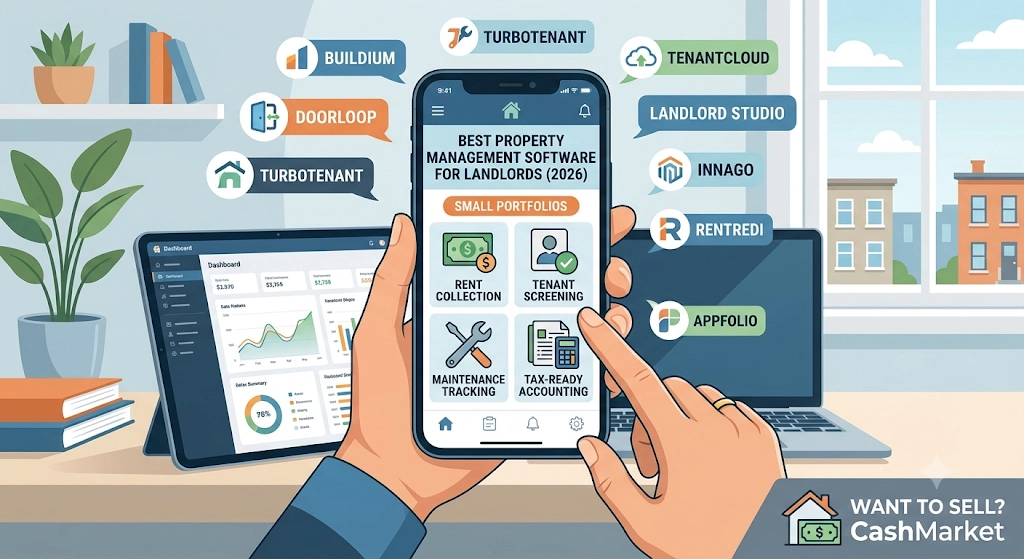
Managing rental property used to mean spreadsheets, sticky notes, and a lot of chasing down rent checks. In 2026, that’s no longer necessary — even for landlords with just a handful of units. A new generation of software handles rent collection, tenant screening, maintenance requests, and tax-ready accounting from a single dashboard, and much of it is priced (or free) for small operators, not just enterprise property managers with hundreds of doors.
And most landlords are small operators. The most common portfolio size is a single unit (42% of landlords), followed by 2–4 units (33%) — meaning roughly 91% of U.S. landlords manage 10 units or fewer. Individual, non-institutional investors own 70.2% of rental properties with four or fewer units, according to Census Bureau data cited by the Congressional Research Service. Most of these owners aren’t full-time property managers, either: 77.4% spend fewer than 20 hours a month on their rentals, and nearly half self-manage rather than hire a third party.
The challenge for this group isn’t finding software, it’s finding the right software for the portfolio size. Many popular platforms are built and priced for professional management companies running 200+ units, which means an independent landlord with five properties can end up paying for tools they’ll never use. That mismatch matters: cost is the single most-cited barrier keeping landlords from adopting digital tools at all, reported by 35% of them. Below is a breakdown of the platforms actually worth considering if you’re managing a small portfolio, plus one option worth knowing about if your goal is to sell rather than manage.
What to Look For
Before comparing tools, it helps to know what actually matters at small scale:
- Rent collection and online payments — ACH and card processing, automatic late fees, and tenant payment reminders
- Tenant screening — background and credit checks integrated into the application flow
- Maintenance tracking — a way for tenants to submit requests and for you to track resolution
- Accounting — income/expense tracking that’s ready for tax season, ideally with a Schedule E report
- Pricing that fits your unit count — flat monthly fees or free tiers designed for landlords, not enterprise per-unit pricing
The Best Options for Small Landlords
Buildium A full-service platform covering accounting, leasing, and maintenance, with association management tools built in. It’s more robust than most small-landlord tools, which makes it a strong pick if you’re actively growing your portfolio rather than staying at a fixed size.
DoorLoop An all-in-one platform with a modern interface, built-in accounting from day one, and workflows that scale as a portfolio grows. It’s a solid middle ground between bare-bones free tools and enterprise software.
TurboTenant One of the most widely used free platforms for independent landlords, covering listings, tenant screening, and rent collection at no cost to the landlord (tenants pay screening fees). A good starting point if you want to test digital tools without committing to a paid plan.
TenantCloud A customizable, feature-rich platform — accounting, lease management, service reminders, tax reporting — with a free tier that makes it easy to try before paying for anything.
Landlord Studio An accounting-first tool built around clean books and a Schedule E-ready tax report, with a free plan covering your first few units. Best suited to landlords who care most about clean financial tracking.
Innago A genuinely free option for landlords with a small number of units, covering the essentials — rent collection, leases, maintenance requests — without the upsells common on other free tiers.
RentRedi A mobile-first app with unlimited properties and tenants under a flat rate, aimed at landlords who want to manage everything from their phone, including maintenance coordination.
AppFolio Powerful and feature-rich, but built for larger operations — typically a poor fit (and overpriced) for portfolios under 50 units. Worth knowing about mainly as the platform to graduate to if your portfolio grows significantly.
The right choice ultimately comes down to portfolio size and what you value most: DoorLoop and Buildium suit landlords planning to scale, TurboTenant and Innago suit landlords who want zero or near-zero cost, and Landlord Studio suits anyone whose top priority is clean, tax-ready accounting. Most of these platforms offer free trials — it’s worth testing at least two before committing.
When the Right Move Isn’t Management Software at All
Not every landlord is trying to optimize how they manage a property; some are trying to get out of managing one altogether. That’s a more common position than it might seem: landlords who self-manage a portfolio of four units or fewer spend an average of roughly $4,600–$5,400 per unit, per year, and cost pressure is now a bigger driver of owner decisions than almost any other factor. If a property has become more of a burden than an asset (deferred maintenance, a difficult tenant situation, financial pressure, or simply not enough time to run it well), the better fit isn’t a management tool. It’s a way to sell quickly.
CashMarket is built for exactly that situation. Rather than a management platform, it’s a marketplace that connects property sellers directly with real estate investors, letting you compare multiple cash offers on a property in one place instead of vetting buyers one at a time. The platform covers most property types landlords are likely to be excited about, including single-family rentals, multi-family apartment buildings, and Airbnb or short-term rental properties.
Because investor buyers purchase as-is, it’s a useful option when a property needs repairs you don’t want to make, when a sale needs to close fast, or when the ongoing cost of managing a unit no longer makes sense. It’s worth being clear-eyed about the tradeoff: cash offers are typically below retail market value, in exchange for speed and certainty. For a landlord who has time and a property in good condition, a realtor and the open market will usually net more. But for landlords facing a fast timeline, distressed property, or simply looking to exit a portfolio, comparing cash offers through a platform like CashMarket can be the more practical path than adding another piece of software to the stack. Landlords weighing the decision can find more detail in CashMarket’s seller resources.
The Bottom Line
For landlords planning to keep and grow a portfolio, the tools above cover nearly every budget and priority from fully free (Innago, TurboTenant) to accounting-focused (Landlord Studio) to built-to-scale (DoorLoop, Buildium). But software only helps if managing the property is still the right call. If it isn’t, comparing offers through a marketplace like CashMarket may be the faster, simpler solution.

