
Digital Twins for Supply Chain Optimization: An Enterprise AI Guide
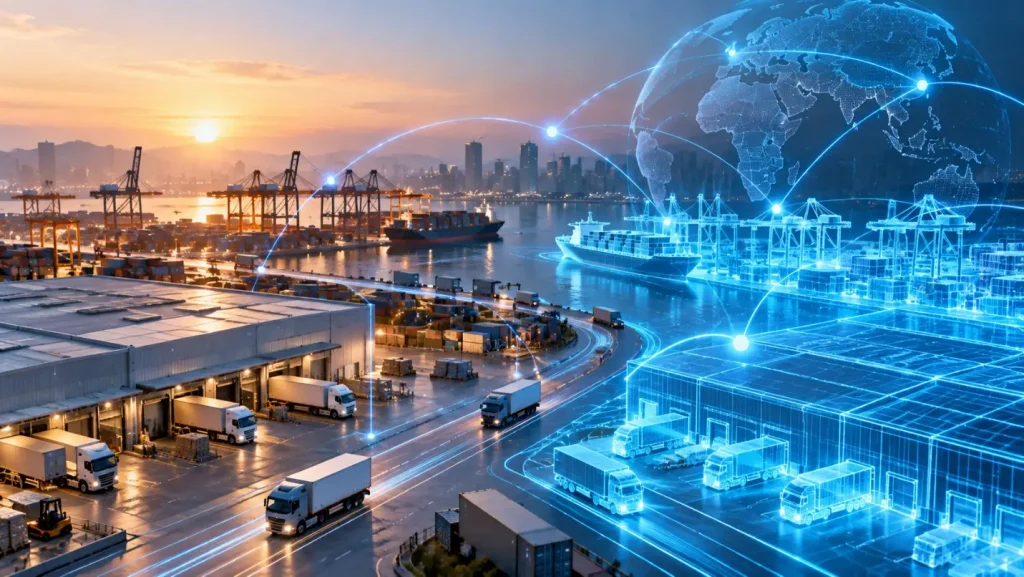
The modern supply chain is no longer a linear progression of moving boxes from point A to point B. It is a highly volatile, globally distributed nervous system. A single container ship stuck in a canal, a localized labor strike, or a sudden spike in raw material costs can trigger compounding failures across continents. For years, enterprises tried to manage this chaos with spreadsheets, historical data, and reactive dashboards.
That era is over. Today, the most resilient logistics networks are running on something far more sophisticated: continuous, self-correcting virtual simulations.
Welcome to the age of the AI digital twins supply chain. By marrying artificial intelligence with hyper-accurate 3D physics and real-time data ingestion, global enterprises are shifting from reactive firefighting to proactive optimization. If you are a logistics engineer, chief supply chain officer, or operations architect, understanding how to deploy these simulated environments is no longer a competitive advantage—it is a baseline survival requirement.
What is an AI digital twin?
An AI digital twin is a dynamic, virtual replica of a physical supply chain that uses real-world telemetry data to continuously update its state. By integrating artificial intelligence, this simulated environment allows logistics engineers to conduct predictive bottleneck analysis, run advanced scenario planning, and automate complex decision-making before executing changes in the real physical world.
The Evolution from Static Models to Dynamic Ecosystems
Historically, supply chain modeling was a static exercise. Logistics teams would pull historical data from an ERP system, build a model of their network, and use it to forecast the next quarter. The problem is that a static model is outdated the second it finishes compiling. It assumes the future will look exactly like the past.
An AI digital twin operates on a fundamentally different architecture. It is not a snapshot; it is a living ecosystem.
When you build a virtual replica of your supply chain, you are mapping every physical asset—warehouses, trucks, shipping lanes, SKUs, and even weather patterns—into a unified data layer. But a digital twin only earns the “AI” prefix when it can learn and adapt. By pulling continuous streams of IoT data (temperature sensors on cold-chain pallets, GPS trackers on freight, API feeds from port authorities), the AI component continuously trains its neural networks.
This enables systems to spot patterns human analysts miss. According to research on supply chain resilience, organizations that adopt advanced digital mapping are significantly better equipped to absorb macro-economic shocks. For a deep dive on how mapping physical networks improves global resilience, Harvard Business Review’s supply chain management resources offer excellent frameworks on structural agility.
To see how these variables interact in real-time, explore the interactive visualization below:
How Logistics Engineers Deploy Simulated Environments
For a logistics engineer, the daily reality involves balancing thousands of interdependent variables. An AI digital twin acts as an infinite sandbox. Because the digital twin mirrors the physical world down to the centimeter—including the layout of specific fulfillment centers—engineers can stress-test the system without risking actual capital or customer satisfaction.
Advanced Scenario Planning
Imagine an enterprise manufacturing electronics. A critical component supplier in Taiwan announces a sudden two-week delay. In a traditional setup, this triggers a frantic scramble: expediting air freight at exorbitant costs or halting production.
With an AI digital twin, the logistics engineer inputs the delay into the simulated environment. The AI instantly runs thousands of Monte Carlo simulations to find the optimal resolution. It checks:
- Current safety stock in regional distribution centers.
- Alternative suppliers in Mexico and their real-time production capacity.
- The exact cost difference between ocean freight from a secondary supplier versus air freight from the primary one.
- The impact on final delivery SLAs for high-tier enterprise clients versus retail channels.
The system then presents the top three most cost-effective strategies, complete with predicted outcomes for each. This capability transforms operations from a guessing game into a precise science. Leading consultancies are already noting this shift. To understand how advanced operations are scaling these capabilities, McKinsey’s insights on supply chain management outline the financial impact of algorithmic decision-making.
Predictive Bottleneck Analysis and Real-Time Telemetry
The true superpower of the AI digital twins supply chain is predictive bottleneck analysis. A bottleneck rarely happens instantly; it builds up over days or weeks through a series of micro-inefficiencies.
The Role of Telemetry
Telemetry is the automated recording and transmission of data from remote sources. In logistics, this means every forklift, shipping container, and automated guided vehicle (AGV) is broadcasting its status.
When this data is fed into the digital twin, the AI monitors the flow velocity. If a specific node—say, the inbound receiving dock at a facility in Chicago—shows a 5% decrease in processing speed over 48 hours, the AI notices. It correlates that slowdown with incoming weather data, truck arrival schedules, and labor shift logs.
Before the physical warehouse manager even realizes they have a problem, the digital twin flags the impending bottleneck. It predicts that in five days, this 5% slowdown will cascade into a severe backlog, delaying outgoing shipments by 24 hours. The system then automatically recommends rerouting inbound freight to a facility in Indianapolis that currently has excess capacity.
For technical insights into how predictive analytics are redefining these processes, MIT Sloan Management Review’s coverage of supply chain analytics highlights the transition from descriptive metrics to prescriptive AI outputs.
The Enterprise ROI of Building a Virtual Replica
Building an enterprise-grade digital twin is a massive undertaking. It requires cleaning legacy data, deploying IoT hardware, and integrating disparate software systems (ERP, WMS, TMS). Chief Financial Officers rightly ask: What is the return on investment?
The ROI manifests across three primary pillars:
- Working Capital Reduction:
Most supply chains hold excess inventory as a buffer against uncertainty. Because an AI digital twin provides high-fidelity visibility into exactly where inventory is and predicts demand with machine-learning accuracy, enterprises can aggressively reduce safety stock. Less inventory sitting in warehouses means millions of dollars in freed-up working capital. - Asset Utilization:
Trucks driving empty (deadheading) and idle warehouse machinery burn cash. By using the digital twin to optimize routing and labor allocation in real-time, asset utilization rates climb significantly. - Risk Mitigation:
The cost of a catastrophic supply chain failure is often measured in lost market share, not just lost revenue. The ability to simulate geopolitical disruptions, natural disasters, or supplier bankruptcies ensures the enterprise has a pre-validated contingency plan.
When mapping out the business case, industry analysts consistently point to these three pillars as the justification for capital expenditure. For broad research on how technology investments are prioritized in this space, Gartner’s supply chain management research provides benchmarking data across industries.
The Architecture of an AI Digital Twin Supply Chain
To actually build this, operations and IT must collaborate to construct a multi-layered architecture. It is not a single piece of software you buy off the shelf; it is an integrated stack.
- The Physical Layer: The actual warehouses, trucks, raw materials, and factory floors.
- The Sensor & Edge Layer: RFID tags, IoT temperature sensors, GPS trackers, and edge computing devices that capture raw telemetry data.
- The Integration (Data) Layer: A massive data lake or cloud infrastructure that ingests structured data (from your SAP or Oracle ERP) and unstructured data (weather feeds, social sentiment, port traffic).
- The Intelligence Layer: The machine learning algorithms, large language models (LLMs), and physics engines that process the data to create the simulation and run the predictive bottleneck analysis.
- The User Experience Layer: The visual dashboard—often rendered in 3D—where logistics engineers interact with the twin, run simulations, and review the AI’s prescriptive recommendations.
Understanding the technical foundation is critical because a digital twin is only as good as its foundational data architecture. A deep dive into the underlying structures of these systems can be found through IBM’s resources on digital twin technology, which detail the integration between IoT networks and AI frameworks.
The Final Node: Erasing the Line Between Physical and Virtual
We are rapidly approaching a state of logistics where human intervention is reserved strictly for high-level strategy and ethical oversight. The AI digital twins supply chain is evolving from a system that merely recommends actions to one that executes them autonomously.
In the near future, when a simulated environment detects a predictive bottleneck, it won’t just alert a logistics engineer. The digital twin will automatically renegotiate a freight contract via API, reroute the ships, adjust the labor schedules in the destination warehouse, and update the customer’s delivery ETAs—all within milliseconds.
For the enterprise, the supply chain is no longer a cost center to be managed. It is an intelligent, self-healing network that acts as a primary driver of competitive differentiation. The companies that embrace the digital twin today are not just simulating their logistics; they are simulating their own future survival.
