
How to Tell If Academic Writing Is AI-Generated: Best Free Detection Tools
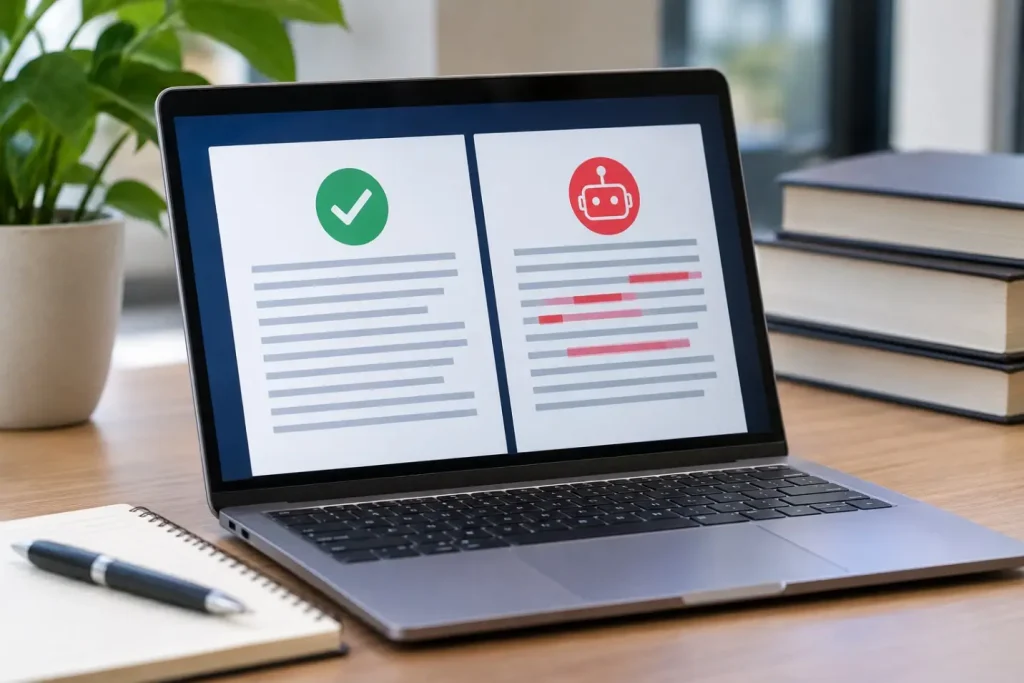
The essay is good. That’s the problem. It’s better than anything this student has handed in all semester: the sentences are balanced, the transitions are smooth, the vocabulary is a notch above the class, and there isn’t a single typo. You read it twice. You want to be pleased. Instead you’re sitting at the kitchen table at 10 p.m. with a cold cup of tea, wondering whether you’re looking at a breakthrough or a chatbot, and knowing that your school’s plagiarism checker was built for copied text, not generated text.
Thousands of teachers have that evening every week now, and most of them don’t have a budget line for enterprise detection software. The good news is that several capable AI detectors offer free tiers that are workable for a single teacher’s needs. The less good news is that none of them is perfect, and using them well matters more than which one you pick. Here’s a practical look at the best free options, what they do well, and how to use them without accusing the wrong student.
AI Writing Is Now Routine in Submitted Work
The scale of the issue is not in doubt. According to Turnitin, its AI writing detector reviewed more than 200 million papers in its first year, and over 22 million of them, about 11 percent, contained at least 20 percent AI-generated writing, while more than six million, about 3 percent, were at least 80 percent AI-written.
One paper in nine with substantial AI content, across every subject and level, is why teachers without institutional tools are looking for free ones.
What Free Detectors Can and Can’t Do
Before comparing tools, it helps to be clear about the limits that apply to all of them:
- They estimate probability, not proof; a score is a signal to look closer, not a verdict
- They’re most reliable on unedited, fully AI-generated text and weakest on human-edited or paraphrased AI output
- They can misfire on formulaic writing, non-native English, and very short samples
- Free tiers usually cap word counts, daily scans, or features
- Results vary between tools on the same text
Used with those limits in mind, free detectors are useful. Used as a judge, they’re dangerous.
What Teachers Say When They Compare Them
Real-world comparisons are more useful than vendor accuracy claims. A teacher-run thread comparing free AI detectors like Turnitin is a good example: contributors tested the same student samples across GPTZero, Sapling, Originality, Copyleaks, and others, benchmarked them against Turnitin, and reported that GPTZero flagged most aggressively while Turnitin was more conservative with fewer false alarms.
Proofademic comes up repeatedly in that discussion as the free option that held up best against humanized or edited AI text in several teachers’ own checks, with one noting that its methodology is published on the vendor’s research page so claims can be examined, though every contributor was careful to say that all the tools are imperfect and none should be used as sole evidence. That consensus, from people grading real papers, is a better guide than any marketing figure.
How to Use a Free Detector Fairly
A detector result is the beginning of a process, not the end:
- Run the text through two tools. Agreement strengthens the signal; disagreement means investigate rather than act
- Look at the writing itself. Compare it with the student’s in-class work, earlier drafts, and known voice
- Check process evidence. Ask for outlines, drafts, version history, or notes
- Talk to the student. A short conversation about the ideas in the essay reveals more than any score
- Document everything. Keep the scores, the samples, and the conversation notes in case of an appeal
- Never act on a score alone. No detector’s output is sufficient evidence of misconduct
A teacher who follows those steps protects honest students and catches dishonest ones more reliably than any single tool.
Designing Assignments That Reduce the Problem
Detection is the last line of defense. The first is assignment design:
- Require drafts, outlines, or annotated bibliographies as graded steps
- Build in personal reflection, class-specific references, or local examples that a chatbot can’t supply
- Use in-class writing to establish each student’s baseline voice
- Ask students to explain or defend their work orally
- Be explicit about what AI use is permitted and what isn’t
Good design shrinks the stack of suspicious essays before any detector runs.
Free Versus Paid: When to Upgrade
Free tiers serve a single teacher checking a handful of papers. Consider a paid plan or an institutional tool when:
- You’re checking dozens of papers a week and hitting limits
- You need batch scanning, reports, or an audit trail for appeals
- Your department wants consistent results across teachers
- Plagiarism detection matters as much as AI detection
Until then, a careful teacher with two free tools and a fair process is well equipped.
Conclusion
The best free AI detectors for checking academic writing are the ones used thoughtfully: GPTZero for a quick, aggressive first pass, a second tool such as Sapling, Originality, or Proofademic to confirm or contradict, and a process that treats every score as a prompt to look closer rather than a finding.
With roughly one paper in nine now containing substantial AI writing, teachers need these tools, but the tools need teachers more, because only a human can weigh a score against a student’s history, voice, and explanation. Run two checks, look at the drafts, have the conversation, and the 10 p.m. essay becomes a question you can answer fairly.

