
Inside Mistral AI CEO Arthur Mensch’s Plan to Democratize Edge Models
The prevailing narrative in Silicon Valley for the past three years has been one of brute force. The hyperscalers and top-tier AI labs—OpenAI, Anthropic, Google DeepMind—have largely operated under the assumption that the path to artificial general intelligence (AGI) is paved with unfathomable amounts of compute, massive parameter counts, and server farms the size of small cities. It is a game of scale, capital, and cloud dominance.
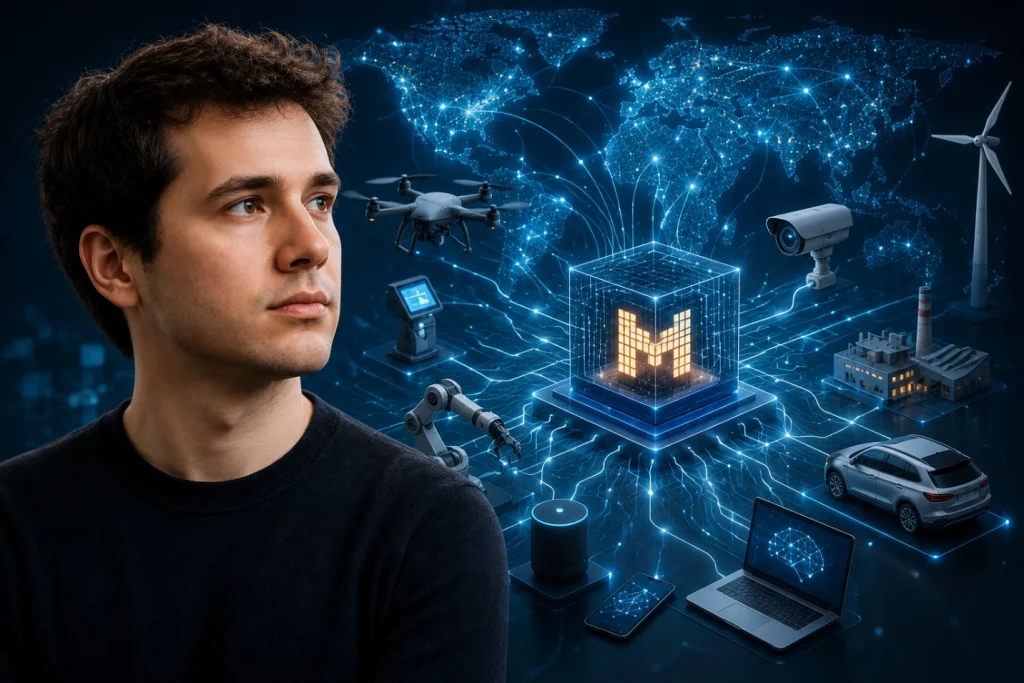
But across the Atlantic, Paris-based Mistral AI is rewriting the rules of engagement. Under the leadership of CEO and co-founder Arthur Mensch, the European unicorn has cultivated a radically different ethos: intelligence shouldn’t just live in the cloud; it needs to live on the edge.
By aggressively shipping highly optimized, open-weight models designed to run locally on enterprise hardware and consumer devices, Mistral is quietly mounting a rebellion against the centralized AI oligopoly. Mensch’s grand strategy isn’t just about competing on benchmark scores—it’s a philosophical and economic push to democratize artificial intelligence, offering sovereign control to developers and businesses who are increasingly wary of outsourcing their corporate brains to third-party APIs.
Here is an inside look at how Arthur Mensch is maneuvering Mistral AI to conquer the edge, the economics driving this shift, and why the future of generative AI might be a lot smaller, faster, and more localized than the tech giants want you to believe.
The Counter-Narrative to Silicon Valley’s Scaling Laws
To understand Mistral’s pivot toward the edge, you have to understand Arthur Mensch’s skepticism of the current AI business model. A former Google DeepMind researcher, Mensch—along with co-founders Timothée Lacroix and Guillaume Lample (both Meta alumni)—saw firsthand the diminishing returns and astronomical burn rates associated with training monolithic models.
In recent media appearances, Mensch has repeatedly highlighted the vulnerabilities inherent in the cloud-heavy approach. In a recent CNBC interview, Mensch discussed three pivotal themes shaping the AI industry: the rise of agentic AI, crippling semiconductor constraints, and the realities of enterprise adoption. The core takeaway? The physical constraints of hardware and the ballooning costs of inference mean that relying solely on API calls to trillion-parameter models is an unsustainable trajectory for most businesses.
Silicon Valley’s reliance on massive cloud infrastructure creates a bottleneck. When every query requires a round trip to a data center packed with NVIDIA H100 GPUs, latency spikes, costs accumulate per token, and most importantly, data privacy becomes a glaring liability. Mensch argues that for generative AI to actually penetrate the traditional economy—manufacturing, defense, healthcare, and finance—the intelligence must be decentralized. It must be decoupled from the hyperscaler tether.
The Sovereign Imperative and the Privacy Moat
The push for edge models is fundamentally a push for digital sovereignty. For European enterprises, and increasingly global conglomerates, shipping proprietary company data to a U.S.-based server to generate a quarterly report or debug a proprietary codebase is a non-starter.
Mensch has been aggressively vocal about the dangers of vendor lock-in and data harvesting. He explicitly warns companies against depending on closed AI models, noting that labs offering proprietary solutions are gaining unprecedented visibility into their customers’ internal workflows. When an enterprise uses a closed AI model, they are essentially migrating their institutional knowledge and “alpha” over to the AI provider.
By pushing highly capable edge models, Mistral offers an alternative: own your weights, own your fate. When a model can run locally on an enterprise’s secure intranet, on a company laptop, or embedded directly within industrial machinery, the data never leaves the premises. This “local-first” architecture effectively neutralizes the privacy risks associated with data exfiltration and regulatory non-compliance (such as GDPR).
Mensch’s strategy capitalizes on this enterprise paranoia. Mistral isn’t just selling a chatbot; they are selling digital independence. The edge model becomes a moat for the enterprise, allowing them to fine-tune AI on their deeply proprietary data without fear of that data being ingested into the next iteration of a competitor’s foundational model.
The Ministral Series and Small 4: Punching Above Their Weight
Mistral’s roadmap over the late 2025 and 2026 cycles has perfectly reflected this edge-centric philosophy. While the company still produces massive frontier models like Mistral Large 3 (a 675-billion parameter behemoth) to compete on the leaderboard, their most disruptive innovations have occurred in the sub-20-billion parameter category.
Enter the Ministral series (3B, 8B, and 14B models). These are not toys. They are robust, highly distilled neural networks designed for edge computing and on-device deployment. Capable of running on standard laptops, smartphones, and embedded systems without a persistent internet connection, these models support massive 128,000-token context windows and multimodal inputs. The Ministral 14B, for instance, has demonstrated reasoning capabilities that outstrip much larger legacy models, making it a darling for developers building local, low-latency applications.
But the crown jewel of Mistral’s edge strategy is the recently released Mistral Small 4. Unveiled as a hybrid powerhouse, Small 4 unified the capabilities of our flagship models—combining the reasoning of Magistral, the multimodal vision of Pixtral, and the agentic coding prowess of Devstral—into a single, highly efficient package.
By unifying these traits, Mistral solved a critical problem for edge computing: the fragmentation of capabilities. Previously, a developer building an on-device application might need separate models for vision processing, text generation, and logical reasoning, which consumed unacceptable amounts of local memory and compute. Small 4 compresses these modalities into one versatile architecture. With a footprint optimized for 4x H100s or even smaller local server setups, it delivers a 40% reduction in end-to-end completion time compared to its predecessors. It is an enterprise-grade brain that can live in a closet server.
The Economics of “Local First”
Mensch is a technologist, but Mistral’s edge strategy is heavily rooted in unit economics. The generative AI boom has created a massive recurring cost center for businesses: API inference fees. Paying $5 to $15 per million tokens for heavy reasoning models quickly evaporates profit margins when deployed at scale across thousands of employees or millions of end-users.
Edge models invert this economic model. By running a model locally or on private edge servers, the marginal cost of generating a token plummets toward the cost of the electricity required to run the local GPU. Mistral’s aggressive pricing and open-weight releases (many under the Apache 2.0 license) allow startups and enterprises to build AI features without signing a blank check to a cloud provider.
Furthermore, efficiency per token dictates user experience. A major frustration with cloud-based AI is latency—the unpredictable lag between prompt and response caused by network congestion and server loads. In contrast, on-device models offer instantaneous generation. For applications requiring real-time interaction—such as autonomous coding agents in IDEs (like Mistral’s Devstral and Codestral), live customer support routing, or voice-to-voice interfaces (powered by Voxtral TTS)—edge execution isn’t just cheaper; it is functionally superior.
Agentic Workflows at the Periphery
Mensch’s vision for the edge extends far beyond text completion. The true endgame of democratized AI is the proliferation of autonomous agents—systems that can plan, reason, and execute complex workflows without constant human hand-holding.
Mistral has heavily leaned into making its edge models “agentic by default.” Their APIs now include native function calling, web search integration, and the Model Context Protocol (MCP) to interact directly with local file systems and databases. When these agentic capabilities are deployed at the edge, they transform end-user devices from passive terminals into active collaborators.
Imagine an engineering firm deploying a local 14B model that has been fine-tuned on decades of proprietary CAD files and structural stress-test data. This edge model acts as an autonomous agent, proactively scanning local engineering drafts for compliance errors in real-time, instantly fetching internal documentation without ever querying the public internet. This is the enterprise reality Mensch is building toward: thousands of specialized, decentralized agents operating securely behind corporate firewalls.
The Final Push to Decentralize Intelligence
The prevailing tech paradigm operates on a pendulum, swinging historically between centralized mainframes (cloud computing) and decentralized personal computing (the edge). Silicon Valley’s current AI boom has violently pulled the pendulum toward centralization, consolidating power, compute, and data into the hands of a few mega-corporations.
Arthur Mensch and Mistral AI are proving that the pendulum is ready to swing back. By aggressively shrinking the footprint of frontier-level intelligence—compressing reasoning, vision, and coding into models small enough to run on local silicon—Mistral is fundamentally altering the power dynamics of the AI industry.
They are proving that you don’t need a trillion parameters to be smart, and you don’t need a hyperscaler cloud to be powerful. In Mensch’s vision, the future of AI isn’t an omniscient, centralized oracle housed in a California data center. It is a hyper-competent, specialized, and secure assistant living right in your pocket and on your local server—democratized, open, and entirely under your control.
