
Inside the Playbook of Mustafa Suleyman: How Microsoft AI is Redefining App-Free Workflows
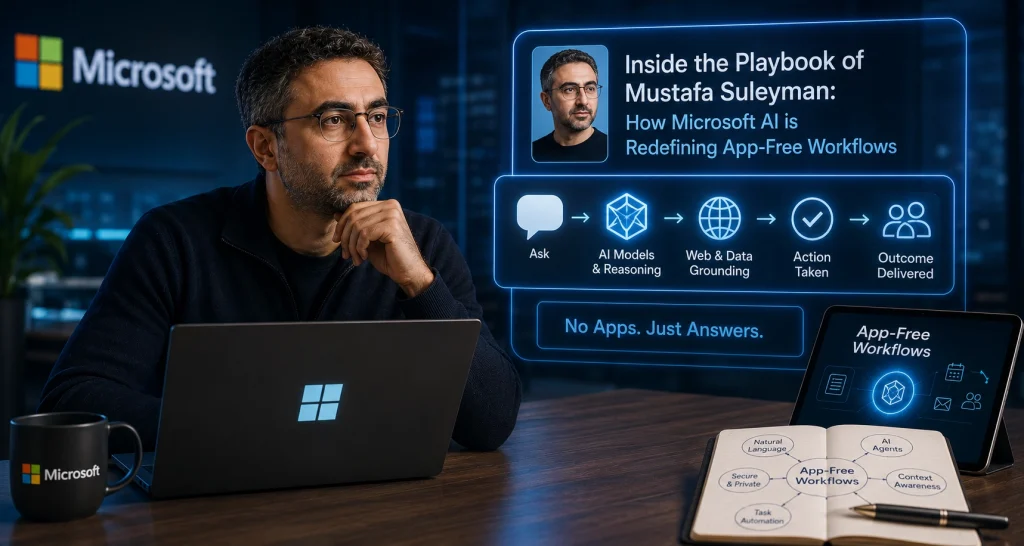
Silicon Valley loves a paradigm shift, but it rarely agrees on what the next one actually looks like. For the past fifteen years, the tech industry has been utterly obsessed with the “app.” We have apps for our workflows, apps for our micro-workflows, and apps to connect the apps we already have. It is a SaaS sprawl of epic proportions, leaving enterprise workers drowning in a sea of tabs, authentications, and disconnected interfaces.
But if you look closely at what is happening deep inside the halls of Redmond, a different reality is taking shape. Mustafa Suleyman, the CEO of Microsoft AI, didn’t join the trillion-dollar behemoth just to slap a conversational wrapper on legacy software. He arrived with a mandate to rip up the traditional user interface and replace it with something far more ambitious. Under his leadership, Microsoft is aggressively engineering a post-app future—a paradigm where computing is defined not by clicking through graphical silos, but by dynamic, agentic AI that executes complex, app-free workflows on the fly.
To understand how Microsoft is executing this pivot, you have to look past the standard keynote rhetoric. The playbook Suleyman is running combines a ruthless drive for in-house model independence, a philosophical commitment to what he calls “Humanist Superintelligence,” and an enterprise go-to-market strategy that threatens to disrupt the very foundation of white-collar work.
Here is the inside look at how Microsoft AI is actively dismantling the app economy.
The App is Dead, Long Live the Agent
To grasp the magnitude of Microsoft’s shift, we have to understand the historical evolution of the digital workspace. First came the Command Line Interface (CLI)—powerful, but hostile to the average user. Then came the Graphical User Interface (GUI), which democratized computing by turning code into clickable metaphors: desktops, folders, and eventually, apps.
For decades, software companies have built their empires on the app model. You want to edit a photo? Open Photoshop. You want to manage customer data? Open Salesforce. Each application is a walled garden, requiring users to learn its specific UI, manage its specific file types, and manually move data across boundaries. We are currently living in the era of peak GUI fatigue.
Mustafa Suleyman’s vision at Microsoft AI fundamentally bypasses this structure. Instead of forcing the user to navigate the machine, the machine is now navigating the digital environment on the user’s behalf. We are transitioning from “software as a tool” to “software as a collaborator.”
Suleyman’s approach is rooted in the belief that creating an AI companion for everyone requires more than just high-parameter language models; it requires a systemic reimagining of how intent translates into action. An app-free workflow means that when a user says, “Prepare a briefing on the Q3 supply chain disruptions and email it to the logistics team,” they don’t have to open a browser, log into an ERP system, export a CSV, open Excel, generate a chart, paste it into Word, and then attach it to an Outlook email. The AI companion handles the routing, the extraction, the synthesis, and the delivery natively.
The application layer becomes invisible. The agent becomes the interface.
Decoupling from OpenAI: The MAI Model Family
You cannot build a bespoke, app-free ecosystem if you are entirely dependent on a third-party API. For the first year of the generative AI boom, Microsoft’s strategy was virtually synonymous with OpenAI. Microsoft provided the compute and the capital; OpenAI provided the frontier models. It was a wildly successful marriage that put Microsoft ahead of Google in the early AI wars.
But Suleyman, a DeepMind co-founder with a fierce independent streak, knows that relying solely on a partner for the core engine of your operating system is a massive strategic vulnerability. At Microsoft Build 2026, the industry saw the first major flex of Microsoft’s newfound self-sufficiency.
Microsoft unveiled a family of seven new AI models developed entirely in-house by its AI Superintelligence Team. This wasn’t just a research update; it was a declaration of independence. Microsoft’s first in-house model family signals a new level of AI ambition, pushing the company from a mere distributor of frontier tech to a primary architect of it.
The Power of MAI-Thinking-1
The flagship of this new ecosystem is MAI-Thinking-1, a 35-billion-active-parameter reasoning model. Unlike traditional Large Language Models (LLMs) that act essentially as sophisticated autocomplete engines, reasoning models are designed to pause, plan, and execute multi-step logic before returning an answer. They possess a “chain of thought.”
In an app-free workflow, reasoning is the critical bottleneck. If an AI agent is going to execute a complex task without human supervision—say, resolving a customer billing dispute by cross-referencing a CRM database, checking a Stripe ledger, and drafting a refund policy—it cannot afford to hallucinate or skip steps. MAI-Thinking-1 is built precisely for this kind of rigorous, step-by-step execution. With a massive 256,000-token context window, it can ingest entire codebases, policy manuals, or financial histories and reliably reason over them without losing the plot.
Zero Distillation and Clean Data
Suleyman has also drawn a hard line in the sand regarding how these models are trained. The industry standard has increasingly leaned toward “distillation”—using the outputs of massive, expensive frontier models (like GPT-4) to train smaller, cheaper models.
Suleyman rejected this approach for the MAI family. Microsoft trained its reasoning models from scratch using clean, commercially licensed data. This isn’t just about taking the moral high ground; it’s a calculated enterprise strategy. Fortune 500 companies are terrified of intellectual property contamination and copyright lawsuits. By ensuring that the MAI models are unpolluted by opaque, unlicensed web scraping or competitor distillation, Microsoft is pitching a sanitized, legally defensible AI foundation. When your goal is to have an AI system running the core workflows of a multi-billion-dollar bank or a healthcare provider, provenance matters just as much as performance.
Agent 365: Killing the SaaS Sprawl
The technology underlying the MAI models is impressive, but the real disruption lies in how Microsoft is productizing it. Enter Agent 365, the enterprise vehicle that turns the promise of app-free workflows into a reality.
While Microsoft 365 Copilot was essentially a smart assistant living inside traditional apps (Word, Excel, PowerPoint), Agent 365 operates across them. It is designed to take bounded, multi-step workflows out of the hands of human operators entirely. Through Copilot Studio, businesses can deploy customized agents that act as autonomous employees.
Imagine an HR onboarding workflow. Traditionally, an HR manager uses an Applicant Tracking System (ATS) to move a candidate to “hired.” They then open an IT portal to provision a laptop, log into an identity management system to create an email address, use a SaaS app to assign training modules, and send a welcome email via Outlook.
With Agent 365, the HR manager simply updates the candidate status. The AI agent detects the state change and automatically provisions the hardware via API, creates the digital identity, assigns the training, and drafts the personalized welcome email for final human approval. The user never opened an app. The workflow was executed purely through agentic orchestration.
These agents are what Suleyman considers the foundational building blocks of a superintelligence. They are not sentient, but they are highly capable micro-systems that can see, reason, and act within the strict boundaries of an enterprise environment. By turning Copilot from a passive text-generator into an active digital worker, Microsoft is steadily moving the value away from the application layer and into the orchestration layer.
Copilot Vision: Context Over Clicks
If Agent 365 is redefining how work happens in the backend, Copilot Vision is redefining how users interact with the frontend. Unveiled as part of Microsoft’s broader consumer push, Copilot Vision represents a massive leap in how AI understands context.
Currently, if you want an AI to help you with something on your screen, you usually have to highlight text, copy it, open an AI chat window, paste it, and write a prompt. It’s a clunky, high-friction process that interrupts the flow of work.
Copilot Vision changes this by establishing a persistent, localized understanding of the user’s screen. It “sees” what you see, understanding both text and images dynamically. If you are looking at a complex spreadsheet of housing prices, you don’t need to export it into an AI tool. You simply invoke Copilot Vision and say, “Which of these neighborhoods has the best price-to-square-footage ratio, and how does it compare to the local transit map?” The AI processes the visual data on the screen, correlates it with web knowledge, and delivers an actionable answer without disrupting your workflow.
This feature is the death knell for niche, single-purpose browser extensions and lightweight utility apps. Why download a separate app to compare prices, translate a messy PDF, or extract data from an image when your operating system’s native AI can simply “look” at the screen and do it for you? By making the AI highly contextual and multimodal, Microsoft is ensuring that the user never has to leave their primary line of sight.
The White-Collar Reckoning: Automation in 18 Months
You can’t discuss Mustafa Suleyman’s playbook without addressing the elephant in the room: the labor market. In a highly publicized and controversial interview, Suleyman stated that AI is on track to automate most, if not all, computer-based tasks performed by white-collar workers within a highly compressed 12 to 18-month timeframe.
The headline caused a predictable panic, with critics accusing Microsoft of building a machine designed to mass-unemploy the middle class. But a closer examination of Suleyman’s philosophy—and the actual enterprise deployment of these tools—reveals a more nuanced, though equally disruptive, reality.
Suleyman was careful to distinguish between tasks and jobs. The app-free workflows Microsoft is building are designed to target the repetitive, connective tissue of modern knowledge work: drafting summaries, routing tickets, formatting data, and moving information between incompatible systems. This is the “glue work” that currently eats up 60% of a white-collar worker’s day.
If an AI agent can handle the data entry, the initial analysis, and the communication routing without opening a single app, what is the human left to do? This is the core challenge for the modern enterprise. Microsoft’s bet is that organizations won’t just fire their staff; they will re-architect the roles.
When you strip away the friction of app navigation and manual data manipulation, humans are freed (or forced, depending on your perspective) to focus entirely on high-judgment, high-stakes work. The junior analyst no longer spends hours formatting a PowerPoint deck; they spend their time validating the strategic assumptions underlying the AI-generated slides. The customer service rep no longer copy-pastes policies; they handle the complex, emotionally charged escalations that require genuine human empathy.
This is the transition from “human as operator” to “human as supervisor.” The AI does the heavy lifting in the background; the human provides the governance, the creative direction, and the final sign-off. It is a fundamental rewiring of the corporate org chart, driven entirely by the shift away from application-centric work.
The Enterprise Deployment Reality: Governance at Scale
Of course, moving to an app-free, agent-driven workflow is not as simple as flipping a switch. The enterprise software market is notoriously risk-averse, and the idea of autonomous AI agents executing tasks across a corporate network is enough to give any Chief Information Security Officer (CISO) a heart attack.
Suleyman and his team understand this, which is why Microsoft is building heavy-duty governance infrastructure alongside its MAI models. If you are going to let an AI agent read your emails, update your CRM, and draft financial reports, you need absolute certainty that it won’t hallucinate a price change or leak confidential data.
Microsoft is addressing this through deep integration with its existing security stack. Tools like Entra Agent ID and Purview are being weaponized for the AI era. Every action taken by an AI agent in Microsoft 365 is logged, authenticated, and bounded by strict permissions. An agent cannot access a document that its human user does not have clearance to read. Furthermore, enterprise administrators can set rigid guardrails on what agents can and cannot do autonomously. They might allow an agent to automatically draft responses to IT tickets, but require explicit human approval before an agent can authorize a purchase order or initiate a wire transfer.
This focus on security and governance is what separates Microsoft’s pragmatic approach from the academic idealism of other AI labs. Suleyman isn’t just trying to build a super-smart model; he is trying to build a deployable, enterprise-grade system that fits into the messy reality of corporate IT. By proving that agentic workflows can be secured, audited, and controlled, Microsoft is slowly dismantling the barriers to widespread enterprise adoption.
The Suleyman Doctrine: Humanist Superintelligence
Beneath the product announcements, the model parameters, and the enterprise strategy lies a deeper philosophical foundation. Suleyman has been highly vocal about his guiding principle at Microsoft AI: the concept of Humanist Superintelligence.
In the broader AI community, there is a vocal faction that views Artificial General Intelligence (AGI) as an end in itself—a relentless pursuit of technological capability, regardless of the societal disruption it might cause. Suleyman, who has spent years thinking about AI safety and containment, vehemently rejects this view.
His vision for Microsoft AI is grounded in the idea that technology must serve humanity, not the other way around. “Great technology experiences are about how you feel, not what’s under the hood,” he wrote recently. The goal of Humanist Superintelligence is not to create an omnipotent, god-like machine that renders humans obsolete. The goal is to build an endlessly adaptable, contextually aware system that amplifies human potential and removes the friction from our digital lives.
This philosophy directly informs the shift toward app-free workflows. For decades, humans have been forced to adapt to the constraints of the machine. We had to learn how to code, how to navigate complex UI menus, and how to speak the rigid language of software applications.
Suleyman’s playbook flips this dynamic. By building reasoning models that understand natural language, visual context, and multi-step logic, Microsoft is forcing the machine to adapt to the human. You no longer have to speak the language of the application; the agent speaks your language, figures out which applications need to be accessed in the background, and executes the task on your behalf.
It is an incredibly ambitious vision—one that requires solving immense technical challenges related to latency, reasoning capabilities, and enterprise security. But if Microsoft can pull it off, it will be the most significant shift in human-computer interaction since the invention of the graphical user interface.
The Post-App Horizon
The transition will not happen overnight. We are not going to wake up tomorrow and uninstall all the software on our hard drives. For the next few years, we will exist in a messy, hybrid state. We will still use traditional apps for deep, specialized work (like video editing or complex 3D rendering), while increasingly offloading our routine tasks to AI agents running in the background.
But the trajectory is clear. The era of the application as the primary unit of computing is coming to an end. The moat for SaaS companies is rapidly evaporating, replaced by a world where AI models interact directly with APIs, entirely bypassing the frontend UI.
Under Mustafa Suleyman’s leadership, Microsoft AI is not just participating in this shift; it is actively accelerating it. By developing its own frontier MAI models, deploying autonomous agents through Microsoft 365, and pioneering contextual understanding with Copilot Vision, the company is building the infrastructure for a post-app world.
For the average knowledge worker, the implications are profound. The digital workspace of 2030 will not look like a desktop littered with icons. It will look like a conversation. You will state your intent, and the machine will orchestrate the outcome. The apps will still exist, buried deep in the server racks, but you will never have to see them again. The agent has arrived, and the way we work will never be the same.
