
Ken Griffin’s Biggest Controversies: From Politics to Wall Street
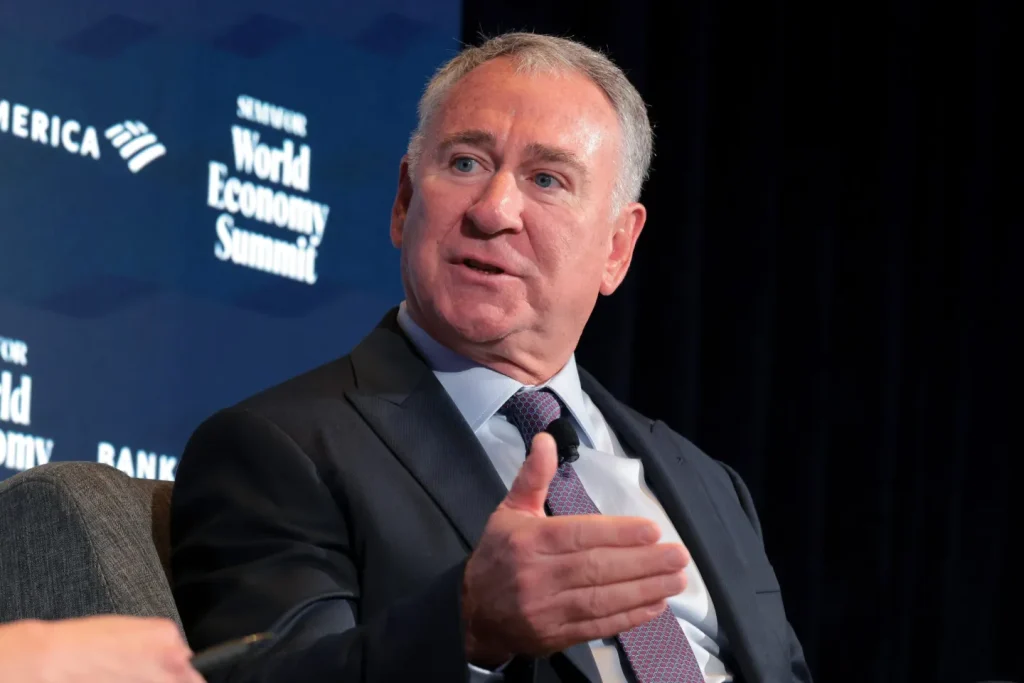
Ken Griffin has long been both prominent on Wall Street and a major political donor. As such, he has attracted controversy in multiple arenas, from his extensive campaign contributions to his firm’s trading practices. Below, we look into some of the most notable disputes and criticisms involving him. In each case, we cite recent reporting and public records for verification.
Political Donations and Influence
Ken Griffin is one of the most active political donors in America. In the 2022 midterm cycle alone, he gave nearly $60 million to federal Republican candidates and committees. This made him the third-biggest political donor of that year. He’s only behind George Soros $128M to Democrats, and far-right GOP donor Richard Uihlein, $62M).
His contributions span a range of candidates and causes, but in recent years, he has leaned more towards Republican causes. During 2019-2020, for example, he wrote dozens of checks, including those of $1 million or more, to GOP super PACs, $25 million to the Senate Leadership Fund alone, totaling about $61 million in that cycle.
-
Early Bipartisan Giving and Shift to the Right
What’s more, he has given hundreds of millions more over decades of campaign cycles. For contrast, his political giving in earlier years included gifts to Democrats. He donated to both Barack Obama and Hillary Clinton in 2008, and even gave $500,000 to President Biden’s 2021 inauguration. But since about 2018, his donations have shifted decisively to the right wing.
Such large contributions have led to accusations that he wields undue influence. Griffin once argued that the ultra-wealthy actually have insufficient influence in politics and therefore give more, which others view as contradictory. In practice, his role as a mega-donor means that he is sought after by politicians.
For example, he was the top donor to Florida Gov. Ron DeSantis’s reelection campaign. According to records, he gifted him $5M in 2018 and another $5M in 2021. He even told reporters in 2022 that he would back DeSantis if he ran for president.
At the same time, he has been a significant funder of Republican leadership PACs. Federal Election Commission data show that Republican Senate and Congressional leadership committees have received the largest chunks of his money.
-
Scrutiny and Potential Conflicts of Interest
This scale of giving means critics and watchdogs watch him closely for conflicts of interest. For instance, during the 2021 House probe of the GameStop trading frenzy, it was widely noted that he had donated to several members of the committee overseeing the hearing.
Griffin tends to describe himself as a Reaganite Republican, and in recent years, he has increasingly spoken out on political issues. In late 2022, he publicly slammed President Donald Trump, calling him a “three-time loser.” He went as far as saying the GOP should move on from him. He told audiences he hoped Trump sees the writing on the wall and does not run again.
At the same time, he expressed enthusiasm for DeSantis, praising the Florida governor’s record. These comments were newsworthy because he is such a high-profile Republican donor. Ultimately, this underscored his growing political profile and also drew fire from Trump allies.
Conversely, he has also been critical of Biden-era policies. At an April 2025 summit, he blamed Trump-era tariffs and threats against the Fed for making the U.S. economy “20% poorer in four weeks.” What’s more, he said Biden’s tighter regulations would give him “four years to focus on business”.
Chicago and Local Controversies
Although a native Floridian, he spent decades in Chicago building Citadel. He has been a major benefactor to Illinois and Chicago institutions. Citadel has given hundreds of millions to state and city causes. For example, Chicago’s public parks and museums bear his name, e.g., the Kenneth C. Griffin Conservatory and the Kenneth C. Griffin Science Park.
That’s due to large donations. In 2023, the Chicago Museum of Science and Industry even renamed itself the Kenneth C. Griffin Museum of Science and Industry. That’s following a major gift from him of about $125 million. Supporters argue these gifts have revitalized city assets.
However, his relationship with Chicago politics has been fraught. He has publicly clashed with local leaders over policy. As early as 2015, he opposed a proposed “rain tax” to fund stormwater projects. More dramatically, in 2021, he fought a planned Illinois income-tax hike. He ultimately spent $54 million to defeat that tax increase, according to ProPublica. Such actions led critics to accuse him of protecting his financial interests at public expense.
Tensions escalated after the social unrest of 2020. In 2022, he stunned Chicago by announcing that Citadel would move its headquarters to Miami, and that he and his family were relocating to Florida. He complained of rising crime in Chicago and said local leaders were distracted or ineffective. The move provoked an outcry. Politicians and critics decried Citadel’s departure as a blow to Illinois, and some saw his subsequent naming gifts as overly self-promotional.
A Chicago Sun-Times reader’s letter captured local sentiment. It was criticizing him for having “abandoned our city by closing Citadel’s Chicago offices” and questioning whether public institutions should carry his name. Another editorial noted that calling him an ultra-conservative GOP mega-donor made his involvement in a Chicago museum controversial, especially since he had moved away.
Tax Issues and Legal Battles
Beyond direct donations, he has also fought policy changes in his home region. As noted, he poured money into defeating Illinois tax increases. In doing so, he faced accusations that his campaign shifted public policy in ways that favored his own business and investments.
His spokespeople, however, counter that he is protecting jobs and the economy, but opponents say he is exercising too much influence. His tax battles remain a sore point in Illinois politics. For example, after the 2020 unrest, he famously warned Chicago’s governor that if crime was not addressed, jobs and taxes would flee. This implicitly signals his willingness to use relocation as leverage.
-
Leak of tax returns and lawsuit
In late 2022, he took the unusual step of suing the IRS and the Treasury Department. This stemmed from a national controversy. In 2021, there was a breach of IRS data that was partially leaked to journalists. ProPublica published a series called The Secret IRS Files detailing how billionaires pay little income tax.
These stories included figures from Griffin’s confidential returns. His lawsuit alleges that government officials “willfully failed to establish appropriate safeguards” and that the IRS “unlawfully disclosed” his tax information to ProPublica. In plain terms, he claims IRS personnel deliberately misused their access to hand over his private returns for publication.
The suit, filed in a Florida federal court, seeks damages and an injunction, arguing that his privacy rights were violated. His lawyers wrote that the leak was unlawful and caused him harm. His complaint and public statements portray him as a victim of government negligence or malfeasance.
Wall Street and Market Controversies
GameStop, Robinhood, and Order Flow
One of Griffin’s most publicized controversies arose from the GameStop short squeeze in January 2021. When Reddit-driven retail investors sent GameStop’s stock price skyrocketing, Citadel became a lightning rod for criticism. His Citadel Securities was the largest market-maker processing U.S. retail trades, including those of Robinhood users. Meanwhile, Citadel’s hedge fund arm was reported to have a short position against GameStop. As such, in late January, its hedge fund division invested $2 billion into Melvin Capital, the hedge fund that had bet heavily against GameStop and was facing massive losses.
This situation raised questions of conflict. Critics pointed out that Citadel Securities earned its hedge fund and affiliates were profiting from bets against the same stock. Senator Elizabeth Warren and others publicly questioned whether Citadel had an unfair advantage or secret role. In a March 2021 letter, Warren wrote that Citadel was supporting a fund that was betting against GameStop shares, while Citadel Securities was making money on the orders of small investors. She and other Democrats called for hearings and transparency on whether Citadel improperly influenced Robinhood’s actions.
Robinhood did indeed temporarily limit GameStop purchases on January 28, 2021. At the time, users speculated that Citadel or other big players had pressured Robinhood. Robinhood and Citadel both denied any collusion, and subsequent investigations found no proof that it directed Robinhood’s trading halt. But the appearance of potential conflict lingered. Its business model relies on such order flow, and its co-founder’s political clout only fueled skepticism that regulators might offer it special treatment. Some retail advocates even called for banning payment-for-order-flow or breaking up Citadel’s business units.
Beyond Congress, the GameStop episode left Citadel’s reputation bruised among some retail traders. Memes and hashtags like #KenGriffinLied circulated on social media, fueled by the perception of double-dealing.
Regulatory Fines and Trading Practices
Citadel Securities, which handles the vast majority of U.S. retail stock orders, has faced several official penalties in recent years. In September 2023, the SEC announced a settlement in which its Securities would pay a $7 million fine. The SEC charged that for five years, Citadel’s automated system incorrectly marked millions of equity orders.
It was mislabeling short sales as long sales and vice versa, which violated Regulation SHO. SEC officials explained the mistake was due to a coding error, but emphasized that mis-marking orders hinders regulators’ ability to monitor short selling. Citadel consented to the fine and agreed to fix its systems, without admitting wrongdoing.
Similarly, in late 2024, FINRA sanctioned Citadel Securities for sloppy trade reporting. Beginning in June 2020, FINRA required firms to report every stock and option order to a centralized audit trail. In October 2024, FINRA announced a $1 million penalty against Citadel Securities for failing to timely and accurately report billions of such orders. The regulator’s report detailed that Citadel had submitted tens of billions of order events with errors in key data fields such as “leaves quantity” and time-in-force codes, and had delayed corrections.
In short, from June 2020 to mid-2024, its order-reporting system had massive coding and timing flaws. Citadel worked with regulators to fix the problems, but under the settlement, it agreed to pay the fine and accept a censure. These enforcement actions illustrate that, despite Citadel’s market prowess, it has not been above the regulatory radar.
Media Portrayal and Legal Pressure
As a powerful figure, Griffin has taken an aggressive stance toward how he and Citadel are portrayed in the media. Two recent examples illustrate the friction.
-
Dumb Money 2023
First, the aforementioned GameStop film Dumb Money 2023 featured a portrayal of Citadel and Griffin. He reportedly was unhappy with his depiction. He hired high-profile lawyers to send nastygrams to the movie’s producers. In August 2023, a legal letter signed by Tom Clare and others warned that the studio could face substantial legal penalties for defamation if the film showed Griffin or Citadel incorrectly.
Clare claimed the original script contained numerous fabrications and that, thanks to his letter, Sony had made corrections. Sony and the film’s directors publicly denied that Griffin had influenced the final product, saying he had no role in shaping it. It even cheekily suggested the controversy would boost interest in the movie.
-
Suing IRS and Media
Second, Griffin has not hesitated to use litigation to defend his privacy. Besides suing the IRS as discussed, he subpoenaed news organizations. In mid-2023, he served subpoenas on ProPublica and individual reporters to produce internal documents and communications related to their IRS tax data stories. ProPublica vowed to fight and protect its sources.
Press freedom advocates criticized the move, saying it put journalistic sources at risk. Supporters of Griffin countered that he was legally entitled to seek evidence in his lawsuit against the IRS. Either way, the subpoenas underscored his readiness to wield the courts in coverage disputes.
Summary
In a nutshell, the controversies surrounding Ken Griffin illustrate the tensions between big money and broad accountability. They also highlight how a figure can attract disparate disputes. On one hand, being accused of undue privilege, and on the other hand, fighting for privacy and image protection. Griffin’s story, however, remains evolving. As of 2025, he continues to be both a driver and target of debate on Wall Street and in politics.
