
Tesla’s Full Self-Driving vs Rivals: How Musk’s Tech Really Stacks Up
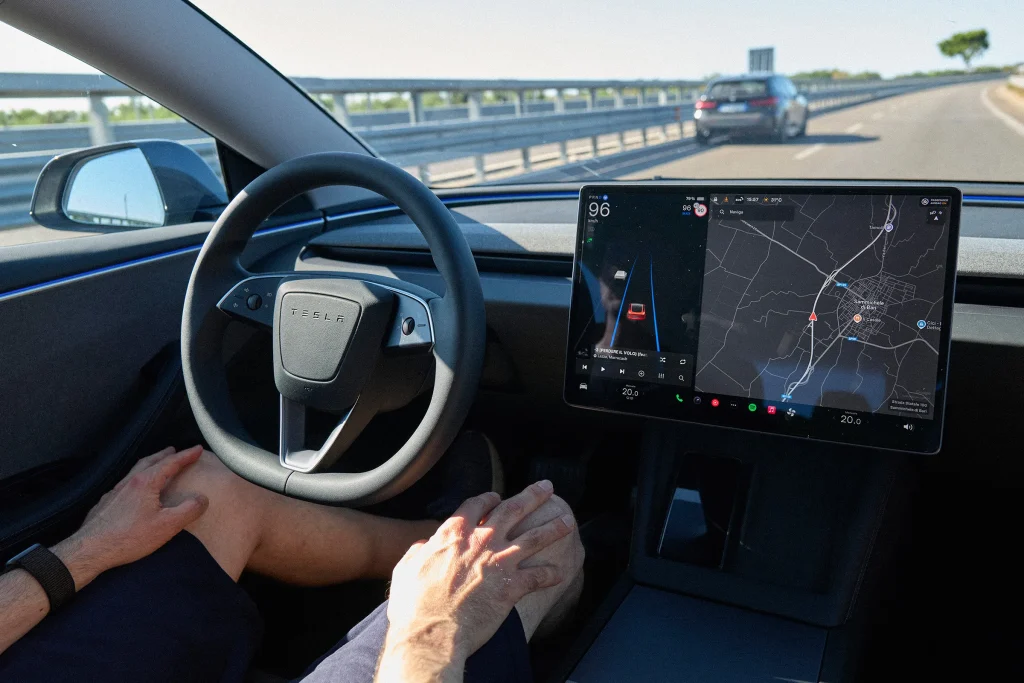
The race to full autonomy has intensified, with tech giants and automakers vying to build the world’s first truly self-driving cars. Tesla’s Full Self-Driving (FSD) is frequently in the headlines, competing with established projects such as Alphabet’s Waymo, GM’s Cruise, and Intel’s Mobileye, among others. However, each company uses different technology stacks, safety approaches, and business models. For example, Waymo already operates thousands of weekly robo-taxi trips in major U.S. cities, racking up over 96 million miles of driverless driving by mid-2025.
In contrast, Tesla’s FSD is still in a Beta phase for consumer vehicles and is legally a supervised system. Analysts describe 2025 as “the year of the robotaxi.” They note that Waymo has a clear lead while Tesla is just ramping up its pilot taxi service in Austin. Today, we compare them on key axes: features, tech, safety records, regulations, costs, public trust, and expert outlooks.
What Tesla FSD Currently Offers
Tesla’s full self-driving is an advanced driver-assist system (SAE Level 2) that automates many driving tasks. However, it still requires a fully attentive human. It can intelligently and accurately complete driving maneuvers such as:
- Navigate on Autopilot
- Traffic-aware cruise control
- City-street driving (in beta)
- Parking
- Summon
On-road FSD can handle acceleration, braking, and steering on most roads, and it recognizes stop lights and signs in its beta form. Tesla emphasizes that FSD is its biggest safety feature. In fact, its Q2 2025 safety report claims just one crash per 6.69 million miles when Autopilot/FSD was engaged. This record is about ten times lower than the U.S. national average.
Despite this, Tesla explicitly states that FSD requires active driver supervision at all times and does not make the vehicle autonomous. In practice, this feature currently operates only with human supervision and often disengages for complex scenarios. The latest FSD Beta releases (v11+) are being rolled out gradually to owners who join the program.
Its stated capabilities are impressive, but Tesla continually reminds users that the system still needs a vigilant driver. Recent releases have improved night and urban driving. But even so, the system is not flawless, and its real-world reliability remains under beta testing.
Tesla’s Full Self-Driving Major Competitors
Several companies have openly ambitious autonomous vehicle programs. They include:
Waymo
Waymo (Alphabet/Google) is widely considered the frontrunner in FSD. It has been testing since 2009 and began a paid driverless taxi service in Phoenix in 2020. The company later expanded to San Francisco, Los Angeles, and Austin. Waymo plans to expand its services to Las Vegas, San Diego, and Detroit in 2026. By 2025, it was already offering about 250,000 autonomous rides per week and had amassed roughly 96 million driver-only miles. Its vehicles are fully autonomous, with no steering wheel or pedals in the cab, and operate in geo-fenced areas.
Cruise
Cruise, owned by GM, is another major player. It ran robotaxis in San Francisco until late 2023. However, after a series of accidents, including a 2023 fatality, GM halted its driverless fleet and shifted focus back to ADAS (advanced driver-assist) technology.
Mobileye
Mobileye, an Intel company, is developing both ADAS chips and its own autonomous driving software. Mobileye’s approach also uses camera-based vision like its EyeQ chips. Additionally, it recently added radar, aiming eventually for L4 autonomy. The company is also running pilot projects in Israel, Europe, and Asia, but has not yet launched a large-scale service like Waymo.
NOTE: Other players include Aptiv/Motional (partnered with Hyundai), Nuro (last-mile delivery bots), and China’s Apollo Go or Pony.ai. Some of them operate robotaxis or delivery vans.
Key Differences in Technology & Sensors
A core contrast lies in the sensor suite and software approach. Tesla famously rejects LiDAR and relies on cameras for perception. As of 2023, Tesla’s full self-driving Beta uses a vision-only approach. For instance, each car carries eight external cameras to feed its neural networks. In contrast, Waymo and Cruise vehicles have multiple cameras, short-range radars, and several LiDAR units.
For example, a Waymo robotaxi comes with 29 cameras, 6 radars, and 5 LiDAR sensors covering all angles. Cruise’s Origin shuttle also uses LiDAR on the roof. These LiDARs (laser scanners) create 3D point clouds and are excellent at detecting obstacles in complex scenes. Tesla contends that a camera-based neural net can eventually match or exceed LiDAR in performance. However, many AV experts argue that Tesla’s lack of LiDAR/radar makes it statistically harder to achieve safety and handle all edge cases.
In software, Tesla’s full self-driving uses an end-to-end AI vision stack that processes raw camera images for driving decisions. Waymo and others build modular systems with separate perception, prediction, and planning layers, heavily aided by detailed high-definition maps.
So far, neither approach is definitively proven superior. Both have trade-offs in complexity, cost, and coverage. However, Mobileye’s approach sits in between. It also favors cameras + radar (and no LiDAR) but is developing advanced vision algorithms to compensate.
Safety Record Comparisons
Tesla
Safety performance is a major point of comparison and controversy. Tesla’s data, which it releases quarterly, shows very long distances between accidents when Autopilot is enabled. For instance, in Q2 2025, it reported 1 accident per 6.69 million miles with Autopilot/FSD active, compared to a U.S. baseline of about 1 per 700,000 miles. However, independent analysts caution that its methodology is biased.
Tesla only counts police-reportable crashes, and most Autopilot miles are highway driving, which is inherently safer. Not surprisingly, when controlling for these factors, the true safety advantage is likely smaller. In fact, a July 2025 Electrek analysis noted Tesla’s miles-per-crash declined slightly in 2025, implying Autopilot regressed by 3% from 2024 levels. Critics also point out that Tesla’s aggressive claims (10x safer than humans) ignore how drivers handle the 5% of the truly hard scenarios.
Moreover, real-world incidents have attracted regulators’ scrutiny. In late 2024, the U.S. safety agency NHTSA opened a formal investigation into 2.4 million Teslas after four crashes. These included a fatal pedestrian accident in 2023, involving FSD usage. NHTSA is examining whether FSD can handle low-visibility conditions and whether Tesla properly reports accidents.
Separately, two fatal crashes were reported in early 2025. One of them, involving a Model S and a motorcyclist in Seattle, has also been linked to FSD mode. As Reuters notes, Tesla’s website insists FSD is always supervised and not fully autonomous.
Waymo
Waymo’s safety record appears very strong by comparison. The company publishes data comparing its robotaxi to human driving in the same cities. As of March 2025, Waymo reported about 81–93% fewer injurious crashes per mile than a human-driven baseline. For example, Business Insider reported its data showed 93% fewer pedestrian injury crashes and 79% fewer crashes requiring airbag deployment vs. humans.
Waymo’s own Safety Impact reports echoed similar results. Furthermore, it rarely has serious injuries. So far, there have been no publicly reported passenger fatalities in its driverless operation. NHTSA data find its collision rate extremely low relative to coverage and ride volume. However, Waymo has also had minor incidents like driving around poles or making sudden stops.
Cruise
Before halting service, Cruise vehicles were involved in a few serious pedestrian incidents. U.S. regulators found at least five collisions between its cars and pedestrians, which Cruise’s software failed to avoid. One infamous October 2023 case in San Francisco involved a Cruise robotaxi that struck and dragged a pedestrian, causing serious injury. Cruise admitted to submitting false information in that case and agreed to fines. Ultimately, these safety failures led California DMV to suspend Cruise’s permit in 2023, and GM pulled funding for the project.
Regulatory Hurdles in U.S. & Abroad
Regulatory regimes for self-driving cars remain unsettled. In the U.S., there is no single federal autonomous-car law yet. Instead, agencies like NHTSA provide guidance, and states set rules. Most states now allow testing or limited operation of AVs, but with requirements. Tesla’s full self-driving is legally just an advanced assist feature, so it fits existing vehicle regulations. However, the company’s moves toward driverless robotaxis will require new approvals.
Indeed, its “Cybercab” concept (robotaxi without pedals) will require explicit NHTSA approval to be road-legal. California historically was progressive in AV regulation, but after safety scares, it has tightened standards. Congress has so far focused more on ADAS oversight than on authorizing full autonomy.
Elsewhere, governments are also proceeding cautiously. For example, Waymo’s move to Washington, D.C., in 2025 has been slowed because D.C. currently does not allow fully autonomous operations without new laws. Europe, on the other hand, is drafting legislation. In 2022, the EU passed new safety rules requiring advanced driver aids on cars. It’s also studying higher automation levels, but it has not yet green-lit true Level 4 robotaxis on roads. The UK and Germany have also created conditional approval for limited L3 systems. As of 2025, Germany allows defined auto-driving under operator oversight on highways.
In Asia, some countries (China, Singapore, Japan) actively test AVs and set road rules, but full deployment is still restricted. In every region, regulators emphasize robust safety validation and want to avoid overpromising. Notably, Tesla itself has faced legal pressure. U.S. Senators urged NHTSA to investigate Tesla’s “misleading” claims about FSD and railroad-crossing behavior. Additionally, EU regulators have scrutiny on how FSD’s marketing works. Overall, regulations are a moving target, and each AV company must navigate a patchwork of rules.
Public Perception of Tesla’s System
The public has a mixed and skeptical opinion of Tesla’s full self-driving. A large U.S. survey found only 14% of Americans said Tesla’s FSD would make them more inclined to buy a Tesla, while 35% said it actively deters them from buying. Worryingly, 48% of respondents said Tesla’s FSD should be illegal over safety fears.
These attitudes reflect that many see FSD as under-delivered relative to its full self-driving name. Media stories and tech bloggers frequently highlight FSD’s mistakes, from phantom braking to failure to stop for crossing bikes. Legal cases, e.g., a Texas family suing over a fatal crash, and continued regulatory probes, reinforce doubts.
Costs and Accessibility
Tesla’s full self-driving has a very different price/access model from its competitors. Tesla sells FSD directly to its customers as an optional package. The one-time price has been raised over time to roughly $15,000 in North America as of 2025, or can be subscribed to monthly $99-$199 per month, depending on vehicle. Essentially, any owner of a recent Tesla, with the required HW3 onboard, can pay to enable FSD features in their car. That makes its system extremely accessible.
In contrast, Waymo and Cruise have not offered their autonomous systems for sale. Waymo’s technology is available only through its ride-hailing service. Riders pay per trip via the Waymo One app. A Business Insider report found that a 5-mile Waymo ride costs about $11, roughly the same as an Uber fare in 2023.
However, a 2025 study cited by BI showed Waymo fares tend to be $5 higher than comparable Uber/Lyft rides on average, reflecting the high cost of driverless operation. Cruise similarly charged ride fares in its SF pilot before shutting down. In other words, Tesla’s FSD is a consumer-paid option, while others monetize AV tech via service fees.
For most people, then, Tesla is far more accessible in terms of availability. Just buy a Tesla, and you can get FSD. Waymo’s service, on the other hand, is restricted to a few cities and requires downloading an app or booking through Uber in Atlanta/Austin. Cruise inched toward a subscription model but never launched publicly.
Expert Forecasts on Who Leads Autonomy
Industry experts are divided on who will ultimately dominate the FSD space. Investment analysts have made bold forecasts. For example, ARK Invest, a famed tech-focused fund, projects a $10 trillion global robotaxi market by 2030. It also believes Tesla could capture the lion’s share. ARK’s analysts calculate that Tesla’s future robotaxi business could represent 90% of its enterprise value by 2029. These prediction is based on Tesla’s ability to scale manufacturing and data collection. They note Tesla’s vision-only neural net and massive fleet give it advantages in cost and learning.
On the other hand, ARK also cautions that Waymo currently has an early lead. By mid-2025, it was logging about 250,000 weekly autonomous rides. Ark’s report even calls 2025 “the year of the robotaxi,” reflecting how young the market still is.
Conclusion: Is Tesla Ahead or Behind?
In late 2025, Tesla’s FSD is neither the clear leader nor the laggard in autonomous driving. On one hand, it has deployed an enormous number of semi-autonomous cars and is rapidly collecting data, giving it the raw material to improve its AI. Its recent entry into the Austin robotaxi pilot shows confidence.
On the other hand, it remains far behind in demonstrating fully driverless mileage. Companies like Waymo have already driven tens of millions of miles without humans, something Tesla has yet to do at scale. Safety metrics and regulatory approval also presently favor Waymo and others.
Ultimately, the question of who leads depends on metrics. If measured in customer vehicles using advanced driver-assist features, Tesla dwarfs the rest. In true L4 autonomy (no safety driver on public roads), Tesla trails Waymo. And if judged by data richness and manufacturing, Tesla has an edge. It may be more accurate to say Tesla is uniquely poised rather than definitively ahead or behind.
