
The Supply Chain Formula: How to Choose the Right Fulfillment Partner to Optimize Business Cash Flow
Most ecommerce businesses do not die from a lack of orders. According to a widely cited U.S. Bank study, 82 percent of small businesses that fail cite cash flow problems as a contributing cause. A store can have growing sales and still collapse, because revenue on a dashboard is not the same as cash in the bank.
For online sellers, the biggest cash flow leaks almost always trace back to the supply chain: capital locked in unsold inventory, slow deliveries that trigger refunds and payout holds, and shipping costs that quietly consume the margin. An inefficient supply chain forces sellers to spend money weeks or months before they earn it back, and that gap is where businesses break.
The good news is that the gap is a choice. The print-on-demand model removes the need to buy inventory before selling it, and the right fulfillment partner turns the supply chain from a cash drain into a cash flow engine. This article lays out a practical formula for evaluating that partner, and shows how platforms like Printway apply it in practice.
How Your Supply Chain Directly Impacts Your Business Cash Flow
Before evaluating partners, it helps to see exactly where a supply chain traps cash. Two mechanisms do most of the damage.
The Trap of Minimum Order Quantities (MOQs)
The traditional wholesale model asks sellers to pay for inventory before a single customer exists. A typical apparel wholesale order means thousands of dollars for stock, plus warehousing, and the seller carries all of the demand risk: if a design misses, the cash is not just delayed, it is gone, sitting on shelves as unsold product. This is the single largest cash flow killer in product businesses, and it compounds every season as sellers guess which designs and sizes will move.
The print on demand supply chain inverts the equation. With a zero-MOQ model, each product is manufactured only after a customer has paid for it. Money leaves the business only when money has already come in, a true pay-as-you-go structure. The seller’s capital stays free for the activities that actually grow revenue (design, marketing, ads) instead of being buried in inventory. For sellers testing new niches or scaling seasonal catalogs, this difference decides whether an experiment costs $50 in ad spend or $5,000 in stock.
Shipping Delays = Delayed Payouts
The second leak is slower and more subtle. Long delivery times increase refund requests and disputes, and refunds do more than reverse a sale: on major marketplaces, elevated refund and late-shipment rates lead to payout holds and reserve requirements, meaning the platform sits on the seller’s money precisely when the seller needs it. In severe cases, sustained late deliveries threaten the account itself.
The fix is structural, not operational: choose a partner with a global fulfillment network that produces close to the end customer. When production happens in the same market as the buyer, realistic delivery windows of 7 to 10 days or less become standard rather than aspirational. Faster delivery means fewer refunds, healthier marketplace metrics, faster payout cycles, and a shorter distance between “customer paid” and “cash available.”
The “Supply Chain Formula” for Choosing a Partner

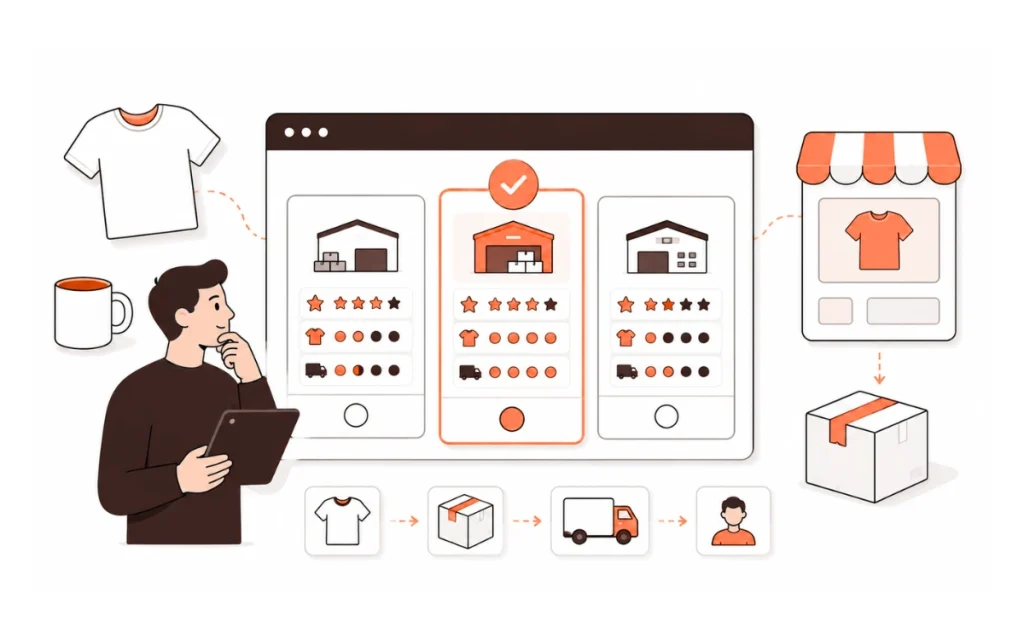
Knowing how to choose a fulfillment partner comes down to three variables. Score any candidate against them, and the cash flow outcome becomes predictable.
Global Fulfillment Network and Local Production
The first variable is geography. A partner with production facilities in your key selling markets (the US, EU, Australia, and low-cost manufacturing hubs such as Vietnam) compresses cost at both ends of the chain. Local production reduces or eliminates import duties on cross-border parcels, cuts first-mile freight, and shortens last-mile delivery to domestic speed. The same order routed intelligently across a multi-country network can cost less and arrive a week earlier than one shipped from a single distant factory, and both improvements land directly on cash flow: lower cost per order, faster payout, fewer refunds.
When evaluatingPOD fulfillment services, ask specifically where physical production happens, not just where warehouses sit, and whether orders route automatically to the facility nearest the buyer.
Seamless Automation and API Integration
The second variable is how orders travel from your store to the production floor. Manual order processing (exporting spreadsheets, re-entering personalization details, uploading files by hand) adds labor cost to every order and introduces the errors that generate remakes and refunds. At ten orders a day it is an annoyance; at a hundred it is a payroll line.
Strong print on demand integration removes that cost entirely. The partner should auto-sync directly with Shopify, Etsy, and WooCommerce, pulling orders, artwork, and personalization data into production without human touch, and pushing tracking numbers back to the store the same way. Printway fulfillment, for example, connects Etsy, Shopify, Amazon, WooCommerce, and TikTok Shop stores in a single dashboard, so a seller managing five storefronts operates them with the effort of one. Automation is a cash flow variable disguised as a convenience feature: it converts a variable per-order cost into effectively zero.
Product Diversity and Quality Consistency
The third variable determines revenue per customer. Acquiring a buyer is the most expensive step in ecommerce, so the partners that maximize cash flow are the ones that let sellers sell that buyer more, without new suppliers, new integrations, or new quality risks.
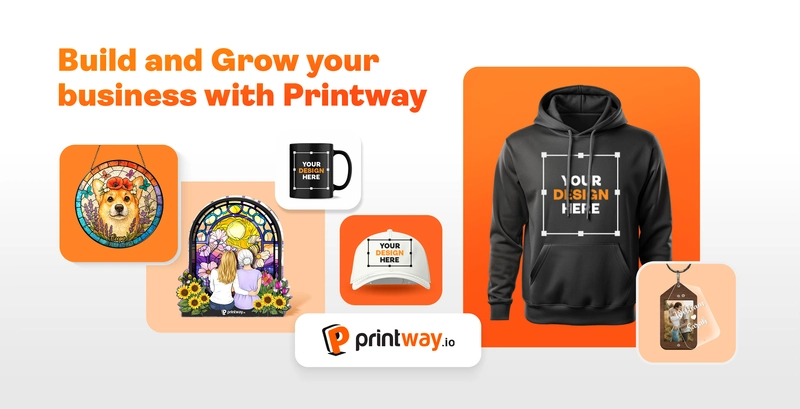
Catalog breadth is what makes that possible. Printway.io maintains a catalog of more than 500 personalizedprint on demand products, spanning Home Decor, Apparel, Drinkware, and specialty items including 3D printed products, all fulfilled through the same integration and quality standards. A seller whose customer just bought a personalized doormat can upsell a matching blanket or ornament from the same production system, raising average order value with zero added operational cost. Quality consistency across that range matters as much as the range itself: one supplier with uniform standards means one set of quality expectations, one packaging standard, and one point of accountability when peak season arrives.
Why Printway Is the Ultimate Cash Flow Optimizer for Global Sellers
Measured against the formula above, Printway solves the merchant cash flow equation on all three variables at once.
Its global production network spans factories in the USA and Vietnam, serving buyers across the US, UK, EU, and Australia with strict, uniform quality standards, so orders are produced near the customer, delivered faster, and refunded less. Its automation covers the full order lifecycle: orders sync from the seller’s store, move through production, and return tracking data automatically, from first click to doorstep, with production turnaround of 1 to 3 business days and peak capacity that absorbs seasonal spikes instead of buckling under them.
And its commercial model is built around the seller’s cash position: no minimum order quantities, no upfront inventory, and custom branding support (white-label packaging) that lets merchants build a real brand on a pay-as-you-go cost structure. The seller’s cash goes to growth; production costs are incurred only against orders already paid for.
Conclusion
Cash flow, not order volume, decides which ecommerce businesses survive, and the supply chain is where most cash flow is won or lost. The formula for choosing a fulfillment partner is short: local production in your key markets, full automation from store to doorstep, and a deep, consistent catalog that grows revenue per customer. A partner that scores well on all three converts your supply chain from the place money disappears into the reason it compounds.
To optimize e-commerce cash flow from the first order rather than repairing it later, sellers can start by auditing their current supply chain against these three variables, and explore what a zero-MOQ, globally fulfilled model looks like in practice at Printway.
