
Top 10 Video Streaming Infrastructure Software Companies for Digital Creators (2026 Guide)
What is the Best Video Streaming Infrastructure Software?
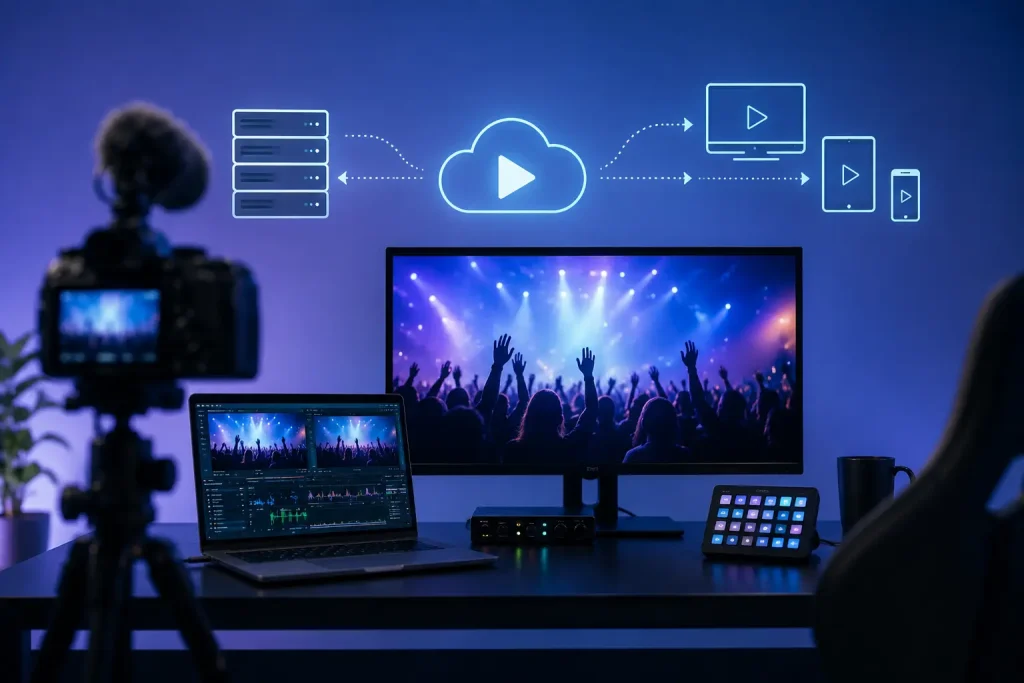
The best video streaming infrastructure software platforms for digital creators are Mux, Amazon IVS, VideoSDK, Agora, and Cloudflare Stream. These platforms provide developer-first Application Programming Interfaces (APIs) and Software Development Kits (SDKs) that automate live video ingestion, cloud transcoding, edge content delivery (CDN), and adaptive playback. By using programmable infrastructure instead of third-party platforms like YouTube or Twitch, creators can embed broadcast-grade, low-latency live streaming and Video on Demand (VOD) directly into their own web and mobile applications while retaining 100% of their audience data and revenue.
The Evolution of Creator Infrastructure: Moving Beyond Walled Gardens
For more than a decade, digital creators and digital media companies distributed content primarily through centralized, ad-supported consumer networks. While platforms like YouTube, Twitch, TikTok, and Instagram provide instant distribution and algorithmic discovery, they impose structural trade-offs that limit business scale:
- Platform Risk & Algorithmic Volatility: Creators are subject to unexpected demonetization, content suppression, and opaque algorithm updates that can cut audience reach overnight.
- Revenue Splits & Monetization Caps: Traditional platforms extract 30% to 50% of advertising and subscription revenue, restricting custom monetization models like micro-transactions, token-gated access, or direct sponsorships.
- Data Siloing: Third-party networks retain direct control of viewer identity, telemetry, and email lists, preventing creators from establishing direct, sovereign customer relationships.
- Custom UX Limitations: Standalone streaming applications cannot embed customized interactive features—such as real-time synchronized shopping carts, custom live betting, interactive polling, or bespoke gamification—into standard consumer platforms.
To solve these issues, creators, digital educators, fitness brands, and media entrepreneurs are building dedicated direct-to-consumer (D2C) applications. However, building custom video infrastructure from scratch requires managing hardware encoders, provisioning cloud transcoding clusters, configuring adaptive bitrate profiles, and negotiating multi-CDN bandwidth contracts.
Video streaming infrastructure software solves this problem by packaging enterprise-grade video delivery into modular, programmable cloud services. By integrating proven video streaming APIs, developers can deploy broadcast pipelines in days rather than months.
Understanding Core Video Streaming Technologies and Protocols
Selecting the right streaming infrastructure requires a solid understanding of the underlying protocols, video processing stages, and latency categories that govern digital distribution.
Video Latency Tiers Explained
Latency is the measurement of time between an event occurring in front of a camera and the video rendering on a viewer’s screen. Streaming infrastructure generally falls into three operational latency tiers:
- Standard Broadcast Latency (10 to 30 seconds): Built on standard HTTP Live Streaming (HLS) and Dynamic Adaptive Streaming over HTTP (DASH). It relies on 2- to 6-second video segments cached across standard web servers. It offers maximum scale and cost efficiency for one-to-many broadcasts where live audience interaction is unnecessary (e.g., linear OTT television, sporting events).
- Low-Latency HLS & DASH (2 to 5 seconds): Employs partial segment chunking (CMAF) to deliver video frames to players before an entire segment finishes generating. This matches traditional cable broadcast speeds and allows for responsive live text chat, community reactions, and synchronized digital overlays.
- Ultra-Low Latency / Real-Time (< 500 milliseconds): Driven by WebRTC (Web Real-Time Communication) or custom UDP-based protocols. Sub-second delivery is mandatory for two-way video communication, virtual classrooms, co-streaming, real-time auctions, and live e-commerce.
Critical Infrastructure Components
- Ingest Protocol Support: The mechanism used by broadcasting software (OBS Studio, vMix, hardware encoders) to transmit feeds to the cloud. Key protocols include RTMP (universal legacy standard), SRT (packet-loss resilient over public internet), and WHIP (standardized WebRTC HTTP ingestion).
- Adaptive Bitrate Streaming (ABR): Cloud transcoding engines immediately convert an incoming 1080p or 4K source stream into multiple resolution ladders (e.g., 1080p, 720p, 480p, 360p). The viewer’s client player dynamically alternates between these bitrates based on real-time network conditions to prevent buffering.
- Content Delivery Network (CDN) Federation: Large video infrastructure companies deploy edge servers globally to cache video manifests and media chunks within milliseconds of the viewer, preventing single-origin bottlenecks during audience surges.
- Video-on-Demand (VOD) Conversion: Automated pipelines that record, index, package, and store live streams as permanent on-demand video files the instant a live broadcast concludes.
Key Technical Criteria for Selecting a Streaming API
When evaluating streaming software providers, engineering and product teams should balance four fundamental technical criteria:
- Time-to-First-Frame (TTFF) & Playback Reliability: Does the provider offer optimized client player SDKs that minimize initial video startup delay and prevent dropped frames across diverse mobile devices?
- Developer Experience (DX) & Documentation: Does the platform offer idiomatic SDKs across major languages (React, Node.js, Swift, Kotlin, Flutter) alongside functional code examples and responsive technical support?
- Cost Predictability: Video costs scale across three distinct dimensions: ingestion time, transcoding volume, and viewer delivery bandwidth (egress). A transparent pricing structure prevents surprise invoices during viral traffic spikes.
- Security & Access Control: Does the infrastructure support signed JSON Web Tokens (JWTs), dynamic digital watermarking, geo-fencing, and Digital Rights Management (Apple FairPlay, Google Widevine) to protect premium creator content?
Top 10 Video Streaming Infrastructure Software Companies
1. Mux
Mux is the benchmark for developer-first video infrastructure. Founded by the engineers behind Video.js and Zencoder, Mux abstracts the complex mechanics of video encoding, storage, and global delivery into lightweight, intuitive REST APIs.
Core Architecture and Features
Mux divides its infrastructure into two specialized engines:
- Mux Video: Manages live stream ingestion, automatic multi-rendition ABR transcoding, automated VOD archiving, and instant MP4 rendition generation for offline viewing. Mux natively supports Low-Latency HLS (LL-HLS), delivering global latencies between 3 and 6 seconds.
- Mux Data: An enterprise-grade video observability platform that monitors viewer Quality of Experience (QoE). It tracks video startup times, rebuffering ratios, exit-before-video-start rates, and playback failures in real time.
Mux’s architecture automatically manages server provisioning, CDN caching across multiple global networks (Fastly, Cloudflare, Akamai), and responsive player components. This allows engineering teams to implement production-grade streaming using a developer-first video API without dedicated video operations teams.
Pricing Structure
- Live Stream Ingest: ~$0.07 per minute.
- Live Stream Delivery: ~$0.0013 per viewer minute delivered.
- VOD Storage: ~$0.005 per minute stored per month.
- Mux Data Monitoring: Tiered usage, including a free monthly tier for basic metrics.
Best Suited For: Creator-led membership platforms, educational courses, and modern D2C media brands that prioritize developer velocity and actionable playback data.
2. Amazon Interactive Video Service (Amazon IVS)
Amazon IVS is a fully managed live video streaming service built directly on the same global infrastructure, hardware transcoders, and edge networks that power Twitch.
Core Architecture and Features
Amazon IVS provides two core streaming configurations:
- Low-Latency Streaming: Delivers video worldwide within 1.5 to 3.5 seconds using an optimized HLS distribution model that can scale to millions of concurrent viewers.
- Real-Time Streaming: Uses WebRTC infrastructure to support interactive video feeds with under 300 milliseconds of latency for up to 10,000 active participants.
A key differentiator for Amazon IVS is its Timed Metadata API. This capability allows developers to inject synchronized JSON data directly into the video stream. Client applications can read these payloads to render interactive components—such as synchronized live quizzes, e-commerce buy buttons, and audience polls—simultaneously across all viewer screens.
Pricing Structure
Amazon IVS uses a utility pricing model based on live ingest hours and viewer delivery hours, separated by resolution tiers (Full HD, HD, SD) and geographic delivery zones. Live output delivery starts at roughly $0.015 per viewer hour for Standard Definition, scaling with higher resolutions and global regions.
Best Suited For: Live shopping apps, esports platforms, and high-volume creator networks that need massive concurrent scale alongside real-time interactive UI overlays.
3. VideoSDK
VideoSDK is an infrastructure platform engineered specifically for ultra-low-latency video, multi-party live streaming, and interactive community apps.
Core Architecture and Features
While standard streaming providers focus primarily on passive, one-directional broadcasts, VideoSDK is designed for dynamic, multi-host participation:
- Interactive Live Streaming (ILS): Allows creators to host interactive sessions where audience members can be promoted to live co-hosts in real time with sub-500-millisecond glass-to-glass latency.
- Native Simulcasting: Ingests high-resolution WebRTC streams and simultaneously transcodes and republishes the broadcast to external RTMP destinations (YouTube, Twitch, Facebook Live).
- Integrated Real-Time AI Infrastructure: Provides server-side native audio noise cancellation, live multi-language transcription, and automated stream summarization.
Developers looking for an interactive real-time communication platform can use VideoSDK’s pre-built UI components and SDKs across Flutter, React Native, iOS, Android, and Web platforms.
Pricing Structure
VideoSDK offers a free tier of 10,000 minutes every month. Subsequent usage is billed per participant minute, with real-time interactive video starting at approximately $0.002 to $0.003 per minute, depending on stream quality.
Best Suited For: Virtual classrooms, fitness platforms with live trainer feedback, interactive creator podcasts, and collaborative community events.
4. Agora
Agora is a market leader in real-time engagement (RTE) infrastructure, powering hundreds of billions of interactive video and audio minutes globally every year.
Core Architecture and Features
Agora’s core strength is its proprietary Software-Defined Real-Time Network (SD-RTN). Operating across hundreds of global data centers, SD-RTN uses machine learning routing algorithms to bypass public internet congestion, minimizing packet loss and video jitter:
- Global Real-Time Scalability: Supports ultra-low-latency real-time video for audiences reaching hundreds of thousands of simultaneous interactive viewers.
- Rich Edge Extensions: Features a marketplace of real-time plugins, including AI spatial audio, voice modulation, dynamic noise reduction, and augmented reality (AR) face filters.
- Broad Device Compatibility: Provides native SDK support for low-spec mobile chipsets and unstable mobile networks across emerging markets.
Pricing Structure
Agora includes 10,000 free minutes every month. Paid tiers operate on a per-minute model based on video resolution:
- Standard Definition (SD): ~$0.99 per 1,000 minutes.
- High Definition (HD): ~$3.99 per 1,000 minutes.
- Full HD (1080p): ~$8.99 per 1,000 minutes.
Best Suited For: Global mobile applications, large-scale virtual conferences, gaming voice-and-video chat, and international social networks.
5. Wowza
Wowza is an established leader in streaming media architecture, offering deep protocol-level control and flexible deployment options for advanced broadcast engineers.
Core Architecture and Features
Wowza operates through two primary offerings:
- Wowza Video: A fully managed cloud service that provides live streaming APIs, automated cloud transcoding, player SDKs, and global CDN delivery.
- Wowza Streaming Engine: Deployable media server software that can be installed on private bare-metal infrastructure, private clouds, or hybrid cloud environments.
Wowza excels at custom ingest configurations. It accepts specialized broadcast and enterprise protocols—such as RTSP, SRT, NDI, and RTMP—and converts them into modern HLS, DASH, or WebRTC streams for global consumer delivery.
Pricing Structure
Wowza Video offers monthly and annual subscription tiers (starting around $175 to $299 per month) that bundle allocated processing hours and bandwidth pools, alongside enterprise contracts for custom on-premises server licensing.
Best Suited For: Broadcasters with complex hardware integrations, professional studio workflows, enterprise security requirements, or hybrid cloud/on-premise needs.
6. Cloudflare Stream
Cloudflare Stream packages video ingestion, encoding, storage, and global delivery into a unified service that runs natively on Cloudflare’s global edge network.
Core Architecture and Features
Cloudflare Stream simplifies video delivery by removing the need to configure separate transcoders, cloud storage buckets, and CDN routing layers:
- Unified Edge Network: Video ingestion and playback occur across Cloudflare’s Anycast network, reducing latency and avoiding extra egress hops.
- Integrated Player & Security: Provides a customizable web player with built-in analytics, dynamic token signing, and domain-locking capabilities to protect content from hotlinking.
- Predictable Billing Structure: Replaces variable bandwidth calculations with a flat-rate pricing model based solely on stored minutes and viewed minutes.
Pricing Structure
- Storage: $5.00 per 1,000 minutes of video stored per month.
- Streaming Delivery: $1.00 per 1,000 minutes of video streamed to viewers.
- No separate encoding fees or variable CDN egress charges.
Best Suited For: Cost-conscious engineering teams, subscription-based VOD platforms, and applications that already use Cloudflare’s security and DNS infrastructure.
7. api.video
api.video provides a unified, end-to-end API designed to handle the entire video lifecycle—from initial upload and live ingestion to global playback and analytics—through a single integration.
Core Architecture and Features
api.video minimizes backend complexity through an intuitive developer workflow:
- Progressive Chunk Ingest: Transcodes video in real time as it uploads, allowing on-demand assets to become playable within seconds of starting an upload.
- Automated Live-to-VOD: Automatically archives live streams into clean, tagged VOD libraries the moment a broadcast ends, complete with automated thumbnail generation.
- Universal SDK Support: Provides active SDKs for JavaScript, Swift, Kotlin, Python, Go, PHP, and modern web frameworks.
Creators looking to deliver on-demand and live-stream videos can use api.video to power private community platforms, e-learning applications, and internal video libraries without complex configurations.
Pricing Structure
- Live Stream Ingest: ~$0.05 per minute.
- Video Transcoding: ~$0.01 per minute.
- Video Storage: ~$0.005 per minute per month.
- Video Delivery: ~$0.0015 per minute viewed.
Best Suited For: Developers building SaaS platforms, digital education portals, and community apps that require live and on-demand video capabilities managed via one clean API.
8. LiveKit
LiveKit is an open-source WebRTC ecosystem engineered for modern real-time video, audio, and data delivery.
Core Architecture and Features
LiveKit is designed around an open-source, high-performance Selective Forwarding Unit (SFU) written in Go:
- True Sub-Second Latency: Delivers glass-to-glass latency under 300 milliseconds across desktop, mobile, and web applications.
- Flexible Hosting Models: Developers can self-host the core server on their own infrastructure under an Apache 2.0 license or use LiveKit Cloud for a globally managed, autoscaling backend.
- Native AI Agent Framework: Offers a dedicated framework for building low-latency conversational AI agents, real-time voice translation, and automated transcription directly inside the live media pipeline.
Pricing Structure
- Self-Hosted: Free and open source (you pay only for your underlying cloud compute/bandwidth).
- LiveKit Cloud: Free tier with 50 GB of bandwidth per month; paid usage starts at ~$0.004 per participant minute.
Best Suited For: Technical teams, open-source projects, real-time AI audio/video products, and collaborative applications requiring low latency and full control over infrastructure.
9. Dacast
Dacast provides a business-oriented streaming platform that pairs developer APIs with turnkey broadcast management and monetization tools.
Core Architecture and Features
Dacast is designed for creators and organizations that need integrated monetization tools without building custom billing backends:
- Integrated Paywall & Payment Gateways: Natively supports recurring subscriptions, pay-per-view (PPV) ticketing, and ad-insertion (AVOD via VAST/VPAID) directly inside the video player.
- Enterprise-Grade Security: Provides AES-128 video encryption, geographic access restrictions, domain referrers, and password-protected streaming.
- White-Label Branding: Completely white-labeled players and URLs ensure no third-party branding appears to the end user.
Pricing Structure
Dacast operates on monthly and annual subscription plans:
- Starter Plan: ~$39/month (includes basic bandwidth allocation).
- Event Plan: ~$63/month (designed for one-time or seasonal event streaming).
- Scale Plan: ~$165/month (includes advanced monetization, API access, and larger bandwidth pools).
Best Suited For: Turnkey pay-per-view events, sports federations, corporate communications, and creators who need monetization out of the box.
10. Bitmovin
Bitmovin is a technology leader in high-performance video encoding, player optimization, and streaming analytics for premium digital media companies.
Core Architecture and Features
Bitmovin focuses on video delivery efficiency, codec optimization, and cross-device playback:
- Next-Gen Codec Optimization: Provides split-and-stitch cloud encoding with support for modern video codecs (AV1, HEVC, VVC, VP9, H.264), reducing bandwidth consumption while maintaining visual quality.
- Adaptive Player SDKs: Provides customizable player SDKs for Web, iOS, Android, Smart TVs (Samsung Tizen, LG webOS), Apple TV, Android TV, and gaming consoles.
- Deep Performance Analytics: Offers diagnostic dashboards that monitor playback health, tracking startup times, CDN switching efficiency, and drop-off points across individual devices.
Pricing Structure
Bitmovin offers pay-as-you-go developer tiers alongside custom enterprise licensing based on encoding minutes, player impressions, and analytics volume.
Best Suited For: Premium OTT platforms, broadcast networks, and applications delivering 4K/UHD video to a broad mix of smart TVs and mobile devices.
Technical Comparison Matrix
| Provider | Primary Latency Tier | Core Ingest Protocols | DRM / Security Support | Open Source Options | Top Developer SDKs |
|---|---|---|---|---|---|
| Mux | LL-HLS (3–6s) | RTMP, SRT | Signed Tokens, JWT | No (Player is Open Source) | Node, Python, Go, React Native, iOS, Android |
| Amazon IVS | LL-HLS (2–4s) & WebRTC | RTMPS, WebRTC | Auth Keys, AWS IAM | No | iOS, Android, Web, React Native, Unity |
| VideoSDK | WebRTC (<500ms) | WebRTC, RTMP | Secure Token Auth | No | React, Flutter, React Native, iOS, Android |
| Agora | SD-RTN (<400ms) | SD-RTN, RTMP, WebRTC | Channel Encryption, Tokens | No | C++, Unity, Flutter, React Native, Native OS |
| Wowza | Configurable (0.5–10s) | RTMP, SRT, RTSP, NDI | AES-128, DRM, Tokens | Engine is on-prem self-hosted | REST API, Java API, Web SDKs |
| Cloudflare Stream | HLS / DASH (2–4s) | RTMP, SRT, HTTP API | Signed URLs, Geo-lock | No | Web Components, iOS, Android, React Native |
| api.video | HLS (2–4s) | RTMP, Progressive | Private Tokens, Signed URLs | No | JS, Swift, Kotlin, Python, Go, PHP |
| LiveKit | WebRTC (<300ms) | WHIP, WebRTC, RTMP | JWT Token Authentication | Yes (Apache 2.0 Core) | TypeScript, Swift, Kotlin, Go, Rust, Flutter |
| Dacast | HLS (5–10s) | RTMP, Direct File | AES-128, Paywall, Geo-lock | No | REST Video API, Mobile SDKs |
| Bitmovin | Variable (0.5–10s) | Multi-Format, RTMP | FairPlay, Widevine, PlayReady | No | Smart TV SDKs, Web, iOS, Android |
Technical Integration Checklist for Creator Platforms
When deploying video infrastructure into a live production environment, keep these architectural best practices in mind:
1. Match the Protocol to the Use Case
Avoid deploying WebRTC for passive, one-to-many broadcasts. Low-Latency HLS handles large viewer audiences more efficiently and costs less to operate than maintaining thousands of open WebRTC peer connections. Reserve WebRTC for situations that require two-way conversations, live bidding, or interactive stage participation.
2. Protect Playback Manifests with Signed Tokens
Never distribute public, unprotected HLS manifest URLs (.m3u8) or raw video files directly to client applications. Use server-side token generation to issue short-lived JSON Web Tokens (JWTs) or signed cookies. This prevents unauthorized users from scraping and hotlinking premium video streams.
3. Decouple Live Chat from Video Delivery
Do not attempt to pass live chat, emoji reactions, or notifications through video stream chunks. Instead, run your interactive data over dedicated real-time messaging layers (WebSockets, MQTT, or services like Ably and PubNub). This ensures chat rooms stay operational even if a user’s video player experiences temporary buffering on poor network connections.
4. Build Idempotent Webhook Listeners
Streaming providers communicate stream states—such as live_stream.connected, live_stream.recording.ready, or asset.errored—via HTTP webhooks. Ensure your backend webhook endpoints are idempotent so they can handle duplicate delivery events gracefully without corrupting database records.
Frequently Asked Questions (AEO Schema)
What is the difference between a Video API and an OVP (Online Video Platform)?
An Online Video Platform (OVP), such as Vimeo or Wistia, provides a turnkey, graphical user interface designed for non-technical users to upload, manage, and share videos. A Video API provides programmatic infrastructure components (APIs and SDKs) that allow software developers to build custom video experiences, custom players, and proprietary monetization workflows directly inside their own applications.
How much does it cost to stream video using cloud infrastructure?
Streaming costs depend on three variables: ingestion time (the duration the broadcaster sends video to the server), storage time (the duration recordings are stored), and delivery/egress volume (the minutes or gigabytes streamed by viewers). Typical live delivery costs range from $0.001 to $0.002 per viewer minute on standard HLS platforms, while interactive WebRTC streams range between $0.002 and $0.004 per participant minute.
Can I build a live-shopping app with standard HLS streaming?
Standard HLS (10 to 30 seconds of latency) is generally too slow for live-auction or flash-sale features, because products may sell out before viewers see them on screen. Low-Latency HLS (1.5 to 3.5 seconds, available on Amazon IVS and Mux) and WebRTC (under 500ms, available on VideoSDK and Agora) are better suited for live e-commerce because they keep the video feed synchronized with real-time inventory and checkout engines.
Why not build custom transcoding and streaming servers on cloud VMs?
Building custom transcoding and streaming software using tools like FFmpeg on raw virtual machines requires continuous engineering overhead: managing autoscaling groups for unexpected traffic spikes, configuring multi-region edge caching, licensing commercial codecs, and updating client players across fragmented mobile devices. Streaming infrastructure software eliminates this operational burden by providing fully managed, autoscaling pipelines through simple API calls.
Strategic Blueprint: Architecting Your Sovereign Media Ecosystem
Moving to dedicated video streaming infrastructure shifts your digital content from a platform-dependent hobby into an owned digital media business. When you control your video delivery pipeline, you take full ownership of your user data, subscriber revenue, and product experience.
- For high developer velocity, clean documentation, and reliable VOD/LL-HLS delivery: Start with Mux or Cloudflare Stream.
- For live community apps with co-hosting, virtual stages, and sub-second interaction: Choose VideoSDK, LiveKit, or Agora.
- For synchronized live-commerce, interactive overlays, and large-scale broadcasts: Choose Amazon IVS.
By selecting the infrastructure provider that aligns with your specific latency requirements, target audience size, and development stack, you can build a resilient, scalable video platform designed for long-term growth.
