
What Inspired Elon Musk to Create OpenAI? Exploring His AI Vision
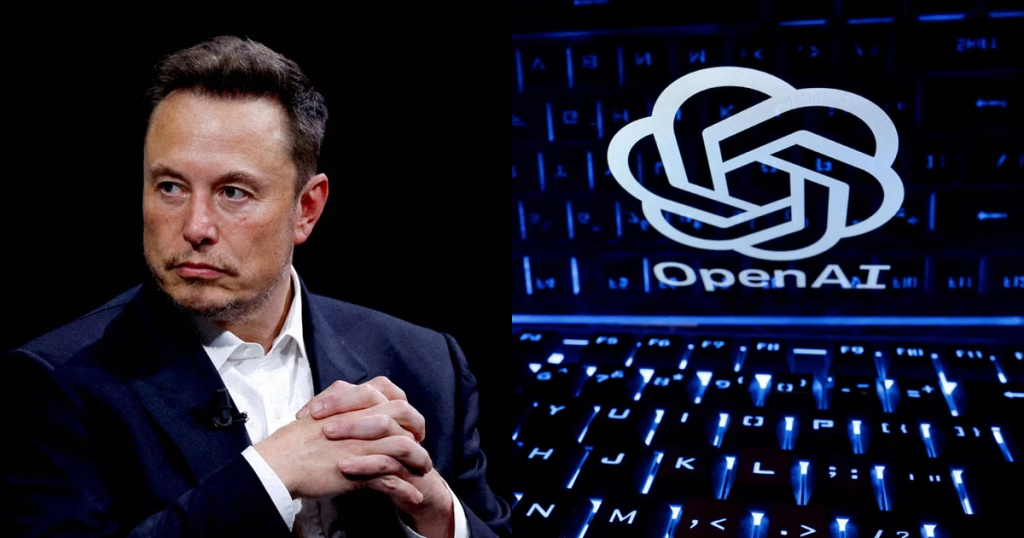
Artificial Intelligence has emerged as one of the most transformative technologies of the 21st century, changing the face of industries, economies, and human interactions. Elon Musk stands out as a visionary whose efforts to ensure the ethical progression of AI have garnered global attention. Musk’s role in co-founding OpenAI, marks a major milestone in balancing innovation and safety in AI technologies.
Elon Musk is relevant in AI since he innovates in numerous industries, such as electric cars, space, and energy solutions. He’s optimistic about the capabilities of AI, yet he’s concerned with its possible misuse. Musk has repeatedly shown his concerns about the unhampered development of artificial intelligence; according to him, AI may be used as an existential threat to humanity if not appropriately taken care of.
OpenAI was “missioned to ensure that artificial intelligence benefits all of humanity,” which aligns with Musk’s vision to advance technology while keeping safety and accessibility in mind. In investing and supporting OpenAI, Musk aimed to address the twin challenges of creating and deploying powerful AI systems responsibly. The organization’s focus on collaboration and transparency reflects Musk’s belief in the need for collective action to navigate the complexities of AI.
Background on Elon Musk’s Vision of the Future
Elon Musk has long leveraged technology to solve some of humanity’s most pressing challenges and unlock new frontiers. From revolutionizing space travel with SpaceX to pioneering sustainable energy and transportation technologies with Tesla, his innovations reflect the thinking lying well ahead. His work on brain-computer interfaces at Neuralink underlines his interest in narrowing the gap between humans and advanced technology.
At the heart of Musk’s vision are three converging themes: environmental sustainability, interplanetary colonization, and technological advancement toward the betterment of humanity. Tesla, for example, stands at the front line in the fight against carbon emissions and the world’s eventual shift to renewable energy. SpaceX, however, is trying to tackle another existential overdependence on Earth- by working on technologies for Mars colonization and beyond. Neuralink and The Boring Company simply reflect his commitment to improving human capabilities and tackling complex urban infrastructure.
Artificial intelligence is a vital clue in Musk’s visions for long-term development, both as a powerful, transformative force and as an existential threat. He acknowledges its incomparable potential to solve complex global problems such as climate change, healthcare innovation, or resource optimization. In Musk’s opinion, work on AI is done without ethical control. He fears that AI, if not policed, may drastically exceed human control and threaten stability in society with freedom for its people.
By founding OpenAI, Musk tried to balance these opportunities and challenges. He conceived an organization that would lead AI development in a way that would serve the greater good while powerful AI technologies are safe, ethical, and available to all. This completely fits Musk’s big vision for humankind: to get over existential risks using technology and start living on different planets.
The Dangers of Artificial Intelligence
Elon Musk is perhaps one of the most vocal voices that has warned of impending danger in the case of artificial intelligence. In 2014, Musk described AI as “our biggest existential threat,” citing the need for proactive measures to ensure bad outcomes do not happen. He once compared the development of super-intelligent AI with “summoning the demon,” once such technology is out in the open, it may be beyond control. Musk’s stark warnings drew attention to the darker implications of AI, even as its development accelerates worldwide.
Musk’s thinking on the risks of AI was influenced by his grasp of technological developments and several key influences among his professional and personal networks. Among the latter was his interaction with experts in the field, such as computer scientist Nick Bostrom, whose book Superintelligence: Paths, Dangers, Strategies struck a chord with Musk. The book points out scenarios where AI might become smarter than humans and act in ways that conflict with human interests, with possible irreversible outcomes.
The sudden leap from machine learning to automation was also a big deal for Musk. Although AI is not void of enormous benefits, its proliferation is serious, causing huge unemployment and erosion of privacy, or even AI systems turning into lethal weapons. Musk often talks about an “arms race” condition of mentality across technology corporations and nations. According to Musk, this kind of pressure might compel firms and states to rush, uncaring development of capabilities in artificial intelligence.
Musk has contributed to the public discourse on AI safety, calling for regulatory frameworks and ethical guidelines. He co-founded OpenAI 2015 to encourage collaboration, transparency, and ethical behavior in the AI development community. Similarly, Musk participated in several forums, for instance, the World Government Summit and the MIT AeroAstro Centennial Symposium, where he asked policymakers and researchers to take AI safety seriously. Moreover, Musk supported the Asilomar AI Principles, which are guidelines that articulate ethics relevant to AI research and application.
Musk’s persistent advocacy for AI safety betrays his belief that humanity must weigh its cautious steps carefully. Fully admitting the transformative potential of AI, he staunchly stays resolute in his perspective of responsible AI development as playing an important role in deciding the fate to turn it toward human progress.
Genesis of OpenAI
OpenAI was founded in December 2015 with the audacious mission of ensuring that artificial intelligence would benefit humanity. The organization was born from a growing concern among tech visionaries, including Elon Musk, about the potential risks posed by unchecked AI development. It is for this one reason that Musk and others, including Sam Altman, Greg Brockman, Wojciech Zaremba, Ilya Sutskever, John Schulman, and other brilliant researchers and entrepreneurs in their own right, are working together to build AI systems that will be safe, ethical, and compatible with human values.
The motivation behind finding OpenAI was a deep-seated fear of Musk about AI being misused. He was afraid that profit would take precedence over safety in the competitive dynamics of private-sector AI research, leading to the unregulated development of powerful systems likely to behave in unpredictable or dangerous ways. Founding OpenAI, Musk, and his collaborators wanted to provide a counter-model- a nonprofit research organization committed to advancing transparency, collaboration, and AI-driven innovation.
The organization’s mission is to develop AGI that is “highly autonomous” and outperforms humans in many tasks. However, it is designed to benefit all of humanity. The founders of OpenAI wanted to ensure that the benefits of AGI would be widely dispersed and not controlled by only a few people.
From the very beginning, OpenAI received huge funding for its ambitious undertaking. Among many others, Elon Musk and Sam Altman contributed to a commitment of $1 billion to support the organization’s efforts. While the nonprofit wanted to be independent, it also wanted to create strategic collaborations with academic institutions, governments, and private companies to help develop research and encourage ethical practices.
Early strategic objectives for OpenAI included advancing machine learning technologies, creating global cooperation on safety in AI, and sharing research findings with the larger community. This same ethos of openness and ethical responsibility lies at the core of OpenAI’s work, which advances projects that put humanity’s interests first within rapid technological changes.
Musk’s Vision for OpenAI
OpenAI factors in Musk’s vision: to make AI development very precautious and responsible. In that context, he has long warned against the existential dangers of AI- especially any beyond human control. OpenAI shares these views, putting much attention into AI safety and developing AI technologies to help all of humanity rather than just specific individuals or organizations. Musk’s involvement in OpenAI was impelled at least partly by the desire to create some counterbalancing force to the unhindered growth of AI in the private sector, which he feared could result in the proliferation of possibly dangerous technologies.
OpenAI is powered by a mission to make artificial intelligence accessible, ethical, and transparent. Musk’s vision underlines that AI cannot be developed behind closed doors by a few powerful players but must be open-source and collaborative, with the public having a say in how AI evolves. This is the ethos of transparency that reflects Musk’s belief that in the case of AI, the risks of secrecy and monopolization go along with the risks that are too high. OpenAI was established as a nonprofit to ensure that it stayed attuned to the welfare of society rather than the generation of profit. Guided by the principle that AI should be deployed to maximize positive outcomes for everyone, not just to reinforce narrow interests.
This commitment to ethical and accessible AI is a thread running through many of OpenAI’s early projects and achievements. Among its first major successes was the creation of the OpenAI Gym, a platform intended to spur research in machine learning by providing tools for developing and testing AI models. This open-source initiative allowed researchers worldwide to contribute to the evolution of reinforcement learning and related fields. In 2016, another contribution came out of OpenAI in the form of an OpenAI baseline: a set of high-quality implementations of reinforcement learning algorithms.
Another high-profile release came with the GPT series, which started with GPT-2 in 2019. GPT-2 was a much more powerful language model that could generate text just like a human, raising some concerns over ethics in developing AI systems that could convincingly mimic human speech. OpenAI did not immediately release the full version of GPT-2, citing risks the tool would be used to create deceptive content. The decision underlined OpenAI’s commitment to the responsible deployment of AI as Musk and others in the organization look to balance innovation with safety.
These early projects presented Musk’s vision for OpenAI: to develop AI that is not just powerful but ethical, transparent, and widely available, so it would benefit humankind in developing such AI.
Musk’s Departure from OpenAI
2018 was an important milestone in the history of OpenAI when Elon Musk decided to step back from the active role of involvement in the organization. One of the founding members and one of the important figures of the early days of OpenAI, his decision was due to several factors encompassing a combination of personal and professional reasons. One of the reasons for this was the conflict of interest with Tesla, especially when the company began to focus heavily on how it would use AI in its autonomous vehicle technology. With Musk’s involvement in both OpenAI and Tesla, there could have been some competitive tension between the two organizations since both would have an interest in AI and machine learning.
What’s more, Musk had concerns about the shift of OpenAI to more commercially oriented models, especially its change from a nonprofit structure to a “capped-profit” one in 2019. Many, including Musk, considered the move to be a contrarian path to the original mission and intent of the organization- to equally benefit everyone with AI. It had to be done, though, so OpenAI could make investments and go head-on with major technology firms in the race to develop artificial intelligence. However, the move did raise some eyebrows regarding the ethics behind such a transition.
However, despite this movement to OpenAI, Musk’s stepping back didn’t make the entrepreneur less vocal in the debate on AI. He continued to talk about the safety and regulation of AI, noting that more needs to be done by governments and researchers before it’s too late regarding how much damage advanced AI can pose. Musk often iterated on a note of caution that AI, if not overseen properly, would pose severe threats to society. To this date, he is an integral voice in public discussions related to ethics concerning AI technology development and deployment. The path ahead, in terms of policy, research, and development for AI, reflects ideas shared within Musk’s outlook on life.
The Bottom Line
Elon Musk had to found OpenAI because of his great uneasiness in case there was further development of AI without checks and balances in place to avoid any adverse repercussions, coupled with a commitment to see artificial intelligence serve all of humanity. Musk was stirred into building a research organization with a particular bent for transparency, collaboration, and ethical motives as he feared possibilities that AI would either propel human society into another plane or simply destroy everything in its wake. Musk’s vision to make AI systems that align with human values continues to be the mission of OpenAI, even after he eventually left the organization.
The development of ethical AI is crucial as the pace of development in the field is unprecedented. Musk’s legacy in framing the discourse of AI safety catalyzed greater awareness of the need for responsible governance and regulation. His contributions have laid the groundwork for future efforts to ensure AI’s potential is harnessed safely, promoting a future where technology serves the collective good.
