
Tesla’s Full Autonomy Dream: The Technical Roadblocks No One Talks About
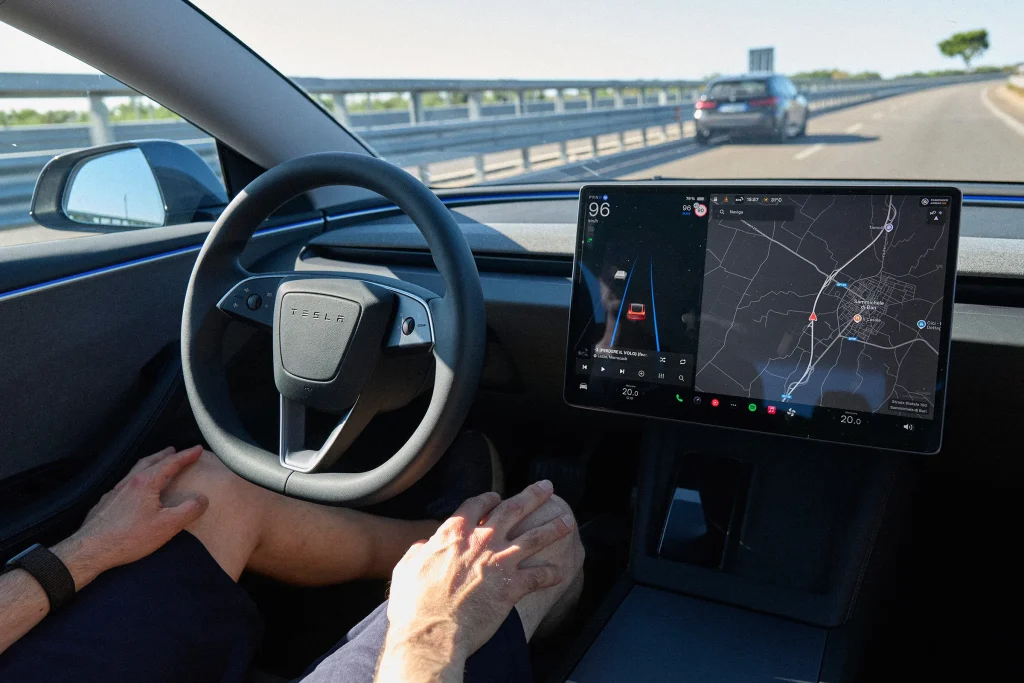
Tesla CEO Elon Musk has repeatedly promised that Tesla vehicles would soon achieve “full self-driving” (FSD). In 2015, he predicted truly autonomous Tesla cars would be on roads within three years, but that deadline passed unmet. Most recently, he forecast that millions of Teslas would be operating fully autonomously by the second half of next year. These grand promises have drawn intense scrutiny, especially as these vehicles currently still require human supervision. But why does Tesla’s full autonomy dream keep hitting a wall? Let’s explore the roadblocks Tesla quietly wrestles with.
Hardware Limitations (Cameras vs LiDAR)
One of the most fundamental debates in Tesla’s approach is its reliance on cameras rather than LiDAR or radar sensors for perception. Its recent innovation, Hardware 4.0, is an all-camera system. By 2023, it had eliminated radar and ultrasonic sensors in favor of a vision-only setup. Tesla argues that high-resolution cameras on its cars can capture color, texture, and context like a human driver. Therefore, the expensive LiDAR units, which emit lasers to map the environment, are unnecessary.
Musk famously joked that “LiDAR is lame” and “friggin’ stupid” for cars. He noted that one unit can cost around $12,000 per vehicle compared to roughly $400 for cameras. In contrast, autonomous rivals like Waymo and Zoox use dozens of sensors to improve object detection. For example, the latest Waymo robotaxi uses about 40 cameras and lidar/radar units, whereas a Tesla has only eight cameras.
Despite Tesla’s confidence, many experts warn that a camera-only system may struggle under challenging conditions. Glare, fog, dust, or darkness can blind cameras, but LiDAR and radar can better penetrate these conditions. Regulators and analysts note that “Tesla’s ‘camera-only’ approach could cause issues in low-visibility conditions.
Studies indicate that even advanced computer vision will still fail to recognize objects about 3% of the time. Absent radar or LiDAR means a missed detection of a pedestrian or motorcycle could be catastrophic. In short, Tesla’s hardware choice dramatically cuts costs and complexity but also limits the raw sensing data available to its AI.
Tesla’s Full Autonomy Dream: Software Training Challenges
Even given powerful hardware and massive data, training the self-driving software remains an immense challenge. Tesla’s FSD depends on massive neural networks that require training on billions of miles of driving data. In theory, more data helps, but experts caution that there are practical limits. Purdue professor Anand Raghunathan warned that simply accumulating more miles may eventually yield diminishing returns. “That will be too costly,” and “we may run out of useful data to train the models.” In other words, pouring more raw driving footage into the AI does not guarantee it learns any new information if the scenarios are mostly repetitive.
Moreover, processing this data requires enormous computing power. Tesla built its Dojo AI supercomputer to train FSD models by running millions of simulated scenarios using video from its fleet. However, Dojo’s development has proven difficult. For instance, scaling custom chip modules posed thermal and interconnect issues. Additionally, Nvidia GPUs, which Tesla also uses, can be expensive and in short supply.
Another training hurdle is generalization. The AI must handle all the real-world variability, including different road markings, sign types, traffic rules, weather, and the behaviors of other drivers. Tesla continually updates its networks via over-the-air software releases, for example, its recent FSD Beta updates. However, each new scenario requires data collection, labeling, and retraining, which is a costly and slow loop.
Tesla’s engineers have so far experimented with “end-to-end” learning, which can scale well with data. But even that approach must eventually be validated in the real world. Musk himself has noted that developing FSD has been “way harder than I originally thought, by far.”
Edge Cases in Driving Data
A key software challenge with Tesla’s full autonomy mission is the so-called “long tail” of driving. These are the rare, unexpected scenarios where the car’s algorithms may fail. Unusual situations, or edge cases, such as a pedestrian suddenly darting onto the road, will always arise, regardless of the amount of data collected. A complex temporary construction zone or a novel vehicle type that lacks representation in the training set could also present a challenge.
Tesla’s approach has largely been to gather millions of miles of real-world footage. They hope to capture some of these rare events within the fleet and subsequently retrain the networks. However, experts note that such work is inherently difficult.
As one former Tesla engineer put it, “It’s impossible for AI systems or their human engineers to anticipate every ‘edge case,’ no matter how much data they analyze. You could argue there are an infinite number of crazy things happening on the road.” Another specialist joked that when an autonomous car encounters an unfamiliar scenario, “it puts its hands up and says, ‘I don’t know what’s going on.’” It essentially stalls until a human intervenes.
Regulatory Barriers Worldwide
Beyond technical hurdles, Tesla faces a patchwork of laws and regulations that vary greatly by region. In the United States, regulators are already investigating its Full Self-Driving (FSD) system. For example, U.S. senators recently urged the National Highway Traffic Safety Administration (NHTSA) to probe failures of Tesla’s FSD system at railroad crossings, warning of “catastrophic” collision risks.
NHTSA opened a preliminary inquiry into 2.4 million Tesla vehicles equipped with FSD after a series of crashes occurred in conditions like sun glare, fog, or dust. The agency has even proposed limiting Tesla’s FSD to the specific road and weather conditions intended for its use. In short, even in the U.S., where autonomous vehicle development is relatively advanced, Tesla’s FSD remains legally limited to supervised use. Additionally, regulators may impose further curbs if safety concerns persist.
In Europe, Tesla’s cars are allowed on public roads, but only under strict limitations. For instance, Tesla FSD-equipped cars in Europe cannot autonomously change lanes on highways without driver approval. Furthermore, they generally won’t navigate complex intersections or roundabouts on their own.
The Netherlands’ RDW authority, which handles EU-wide approvals, has required Tesla to conduct extensive testing and obtain special permits before expanding FSD to new countries. Tesla executives have referred to this process as a “layered bureaucracy.” In practice, this means Tesla must adapt to EU safety regulations, signage, and testing protocols, all of which require time and money.
The Chinese government has mandated strict data security rules that currently prevent Tesla from sending the driving data it collects in China back to its servers for training its AI. Tesla has reported that it is still negotiating with the country’s officials to allow the export of that data. Without it, Tesla cannot fully include Chinese driving conditions in its global training.
Safety vs Speed of Rollout
Tesla’s development style has been to implement quickly, like often beta-testing new FSD software with real customers. However, that rapid pace carries safety risks. The company frequently updates its fleet via over-the-air patches, which allows rapid improvements. However, this approach also means that any software issue can immediately affect millions of cars.
Musk has publicly stated that Tesla is committed to safety and will implement FSD with caution. Indeed, Tesla has incorporated driver-monitoring cameras and a “strike system” to guarantee user alertness during Autopilot engagement. In principle, these measures help mitigate one risk of partial automation: driver complacency.
However, observers express concern that Tesla’s messaging occasionally conveys contradictory messages. A recent Wired report highlighted new in-car prompts that say things like “Drowsiness detected; stay focused with FSD.” Thus, experts fear it could encourage drivers to rely on FSD when they are tired, exactly when they should be most vigilant. More broadly, as Level 2 systems become more capable, drivers are increasingly tempted to engage in secondary tasks, potentially leading to dangerous misuse.
Tesla’s public hype and ambitious timelines intensify this tension, potentially pressuring the company to implement features before they are completely safe. For example, in 2023, a jury found Tesla partly liable for a fatal crash involving Autopilot. California regulators have also accused it of overstating the capabilities of its “Full Self-Driving” marketing. These events underscore that rushing to market with imperfect autonomy risks eroding public trust and could even trigger regulatory crackdowns.
AI Chip Development
Behind the scenes, Tesla’s full autonomy efforts have also centered on custom AI hardware. Starting with the 2019 “Hardware 3” FSD computer, the automaker designed specialized in-car chips to run its neural networks. Meanwhile, to train those networks, it began developing Dojo, a supercomputer built around its own D1 processor chips, to handle massive video data.
The D1 chip, unveiled in 2021, was a 7-nanometer design featuring 50 billion transistors for high AI-training efficiency. Tesla hoped Dojo would achieve exaflop-scale performance. However, by mid-2024, it became clear that Dojo faced technical and organizational hurdles such as heat dissipation and long development cycles.
The automaker spent years building out a large AI-training cluster (called “Cortex”) with tens of thousands of GPUs. In Q2 2025, it reported adding 16,000 Nvidia H200 GPUs to Cortex, bringing it to the equivalent of 67,000 H100 GPUs, to train the latest Tesla’s full autonomy vehicle models. However, although Tesla had poured resources into Dojo, by late 2025, Musk abruptly disbanded the in-house team.
He stated Tesla would streamline its chip efforts by focusing on inference chips, for real-time in-car decision-making, rather than separate training chips. This pivot means Tesla plans to partner with chip firms instead of solely using in-house designs. Indeed, reports indicate the automaker is all-in on partnerships with Nvidia, AMD, and Samsung to build its next-generation AI accelerator.
Tesla’s Data Advantage (Fleet Learning)
Despite the challenges above, Tesla does have one major advantage: an enormous stream of real-world driving data. Every Tesla on the road is essentially a data-collection device. With over 5 million cars fitted with Autopilot/FSD hardware globally, the fleet logs billions of miles annually.
Tesla uses this data to continuously refine its AI. The company’s servers receive anonymized video and sensor data from corner cases, label them, and use them to retrain the neural networks. This fleet learning model enables Tesla to observe rare events nationwide and quickly push improvements via software updates. By contrast, most competitors have far smaller testing fleets (Waymo’s has been on the order of thousands of cars in a few cities).
Competition Pushing Ahead
Tesla is far from alone in the self-driving race, and many competitors are making rapid progress. In the U.S., Alphabet’s Waymo has arguably the most advanced autonomous fleet. It has been operating commercial robotaxi services for years, using high-definition maps and a full sensor suite. Waymo reports driving thousands of miles without any driver in city traffic, reflecting a very high reliability.
By contrast, crowd-sourced data suggest that currently, Tesla’s full autonomy models average only a few dozen miles between critical disengagements. John Krafcik, the former CEO of Waymo, has observed that Waymo’s additional sensors significantly enhance its ability to perceive the environment, particularly in adverse weather conditions, compared to Tesla. Other U.S. players include GM’s Cruise, Amazon-owned Zoox, and even Apple are rumored to be developing a sensor-rich self-driving car. Each of these companies typically takes a more conservative, redundant-technology approach than Tesla.
In Europe, traditional automakers (Volkswagen, Daimler, and BMW) are developing L2/L3 systems, often with LiDAR, under tight safety regulations. In Asia, Toyota and Hyundai are among global automakers pushing robotaxi pilots and aiming for commercialization later in this decade. Even in the startup community, multiple well-funded ventures such as Nuro for delivery robots, Aurora Innovation, etc., are racing in the AV space.
While Tesla’s bold vision generated early hype, many competitors have maintained their focus on tangible milestones. They are gradually constructing fleets, conducting validation in urban areas, and obtaining regulatory approval. As one analyst noted, Waymo has spent many years preparing its environments before rollout, whereas Tesla’s grand announcements have often outpaced its readiness.
Conclusion: Is Musk’s Vision Achievable?
Tesla’s full autonomy dream requires a brutal reality check. The company has unmatched data collection, millions of vehicles already on roads, a loyal customer base willing to pay for FSD, and significant computational resources. However, the roadblocks are formidable. Current expert opinion is that the camera-only approach will fail to deliver unsupervised self-driving. Sensor redundancy is the only logical way to have a safe self-driving solution at scale. Tesla’s insistence on vision-only systems may prove its greatest strategic mistake.
Meanwhile, regulators worldwide are skeptical. Many require that a human driver remain ready to take over. These strict testing rules are slowing Tesla’s FSD expansion. With significant advancements in hardware, software, and data processing, Tesla could develop a Level 5 system within a broader operational domain by 2030-2035. Musk’s vision isn’t impossible—it’s just much harder than he’s ever admitted publicly.
